
Kettering archaeological dig reveals hidden secrets of 'huge' 'high status' Roman villa
History lovers have been invited to visit the site of a Roman villa near Kettering currently being investigated in an archaeological dig by students from the University of Cranfield.
Visitors to the open day will be able to look at artefacts found in the remains of a ‘huge’ homestead with spa discovered on private land in fields overlooking the Ise Valley.
Archaeologists have already excavated a bathhouse complex in one corner of the building which would have been a ‘high status’ home dating from 3AD to the 4th century.
Dr David Errickson, senior lecturer in forensic archaeology and anthropology at Cranfield’s Forensic Institute, will be on hand to interpret the scene.


He said: “It would be a higher status villa. It’s a wonderful thing – it’s textbook archaeology. It’s what you see in Roman Britain but rare that it’s so well preserved.”
Now in its fourth season, this year the team has uncovered an underfloor heating ‘hypocaust’, including stacks of tiles known as ‘pilae’ used to create the space for hot air.
Parts of a brightly coloured mosaic hint at what could be discovered under the collapsed limestone walls of the villa, which once overlooked Roman Kettering – now under Stamford Road’s estates.
Fragments of glass reveal the villa had glazed windows, and brightly coloured plaster shows the walls would have been yellow and burgundy. The roof tiles are made of local Collyweston slate and clay ones made locally. Some of the tiles feature animal tracks, hobnails from Roman footwear and even one of the maker’s fingerprints.
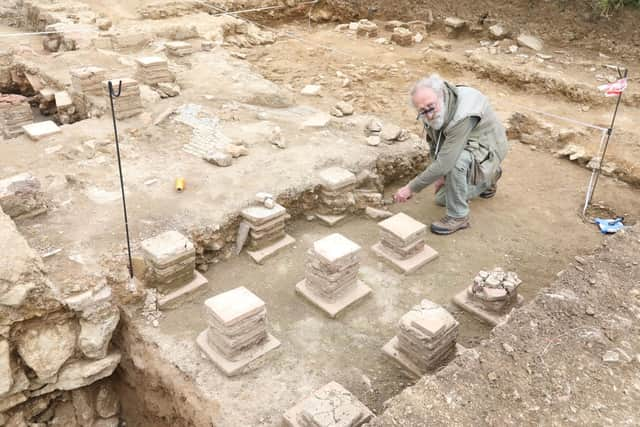
Roman Kettering would have been east of the current town centre, which developed later in the medieval period. After the villa was abandoned, building materials from the walls and roof would have been taken by locals to build their own homes.
Chris Chinnock, from Kettering, who works for Museum of London Archaeology service (MOLA), has been working on the dig to bring his expertise to help the students.
He said: “It has been challenging. It’s quite a complex one [dig]. It’s not often that you’ll get to work on a site like this – it’s a huge villa. It’s a privilege to work on.”
Mr Chinnock added: “There are loads of villas in this area and in the Ise Valley.”
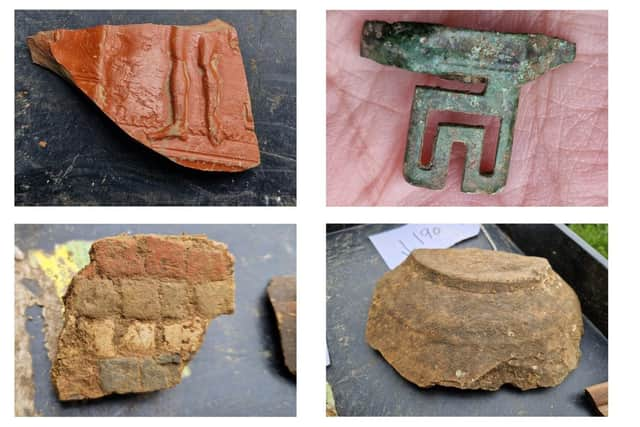
With only a fraction of the site excavated and the dig only taking place one month a year, the project is a long-term one. Next year investigations using geo-physical data will be used to find more evidence of a Roman road which is thought to have run from Barton Seagrave to Geddington.
Volunteer Steve Sharpe, from Kettering, who has been working on the site for the past three years, has been excavating the ‘Caldarium’ – the warm air bathing room – and what is thought to be a plunge pool.
He said: “It’s very exciting. I’ve known this land all my life and to think it was here hidden all along. It’s not the sort of thing you ever think you are going to find.”
It is hoped that in the future schools and youth groups could use the site for educational visits.
To take part in escorted guided tours of the monitored site go to Warkton Church on Saturday June 8, from 11am to 4pm where artefacts will be on display.