
Corby child cancer rates 'no higher than expected' says new council-commissioned report
North Northamptonshire Council (NNC) has shared findings of an expanded independent analysis of cancer registrations among children and young adults living in the Corby area.
An expanded study was commissioned following requests from concerned local residents for further investigation into cancer rates in Corby.
The new study again says that childhood cancer is no more prevalent around Deene quarry than in other areas of Northamptonshire.
But local campaigner Alison Gaffney has already raised questions over the study, saying the area it covers is not wide enough and that their fight will continue.

The new report builds on previous analysis published in January 2026 by considering a wider age range and a longer time period – but uses the same geographical areas.
Analysis took national and local data. Using the ‘Lower Super Output Areas’ (LSOAs), that divides the town in small areas and data from ‘cluster LSOAs’ – areas within 5km of Deene Quarry, the historic former steelworks dumping ground – numbers were compared.
The study into the data by the National Disease Registration Service (NDRS) concludes that no ‘clear’ evidence that cancer rates among children and young adults in the cluster were different from those seen in the rest of Corby, Northamptonshire, the East Midlands or England.
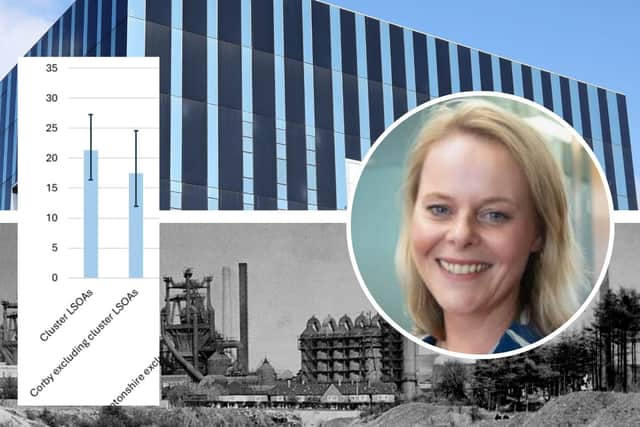
Figures in the report reveal 21.3 out of 100,000 children and young people were registered with a malignant cancer in the neighbourhoods around Deene quarry.
The figure for Corby excluding this area, shows a lower figure of 17.5 out of 100,000 children and young people registered with a malignant cancer. But the report says this difference is not “statistically significant”.
Dr Jane Bethea, director of Public Health for North Northamptonshire, said: “We recognise that concerns about cancer rates in this area have been deeply felt by some residents, and it is important that those concerns are taken seriously and investigated thoroughly.
“This latest analysis, carried out independently by the National Disease Registration Service, builds on the work published earlier this year by examining a wider age range and more than two decades of data.
“The findings are broadly consistent with the conclusions of the previous report. Analysis of the best available data about cancer diagnoses in our population has found that there is no clear evidence that the rate of cancer in children and young people living within 5km of Deene Quarry is higher or lower than would be expected based on rates seen elsewhere in Corby, Northamptonshire, the East Midlands or England.
“This independent assessment provides the most comprehensive analysis available for this population and time period.”
The new study examined cancer registrations among children and young adults aged 0 to 24 years that occurred between 2001 and 2023, while the previous report considered registrations among people aged 0 to 19 years that occurred between 2013 and 2022.
The previous analysis published in January 2026 found a slightly lower rate of cancer in children and young people in the area near Deene Quarry compared with other areas, while this expanded analysis found a slightly higher rate.
The report states: “However, none of these findings were statistically significant, meaning that the differences observed are likely to reflect natural variation rather than a genuine difference in cancer rates.”
People have been cautioned the results of the previous and expanded analyses ‘cannot be directly compared’ because they cover different age groups and time periods.
The report states that despite the expanded age range and longer time period being considered, the number of cases is still relatively small.
Adding: “Despite the expanded age range and longer time period considered, the number of cases is still relatively small. Rates and ratios calculated using small numbers can be unstable and should be interpreted with caution.”
Cllr Martin Griffiths, leader of North Northamptonshire Council, said: “We asked for this further analysis after residents sought additional reassurance and requested that a broader range of data be considered.
“As a council, we have been committed to ensuring that residents’ questions are heard and that independent expert advice is obtained wherever possible.
“We recognise that a cancer diagnosis, particularly involving a child or young person, is deeply distressing for families, and that concerns about why it happened are entirely understandable. These experiences are very real and important, which is why it is vital that they are carefully considered alongside robust population-level evidence.
“This expanded study has looked at a larger population, over a much longer time period. It found no clear evidence that cancer rates among children and young adults living within the study area are different from those experienced elsewhere.
“I would like to thank the residents who raised these concerns, and the National Disease Registration Service for carrying out this detailed and independent analysis.”
Alison Gaffney, who runs the Corby Childhood Cancer campaign with her husband Andy, said that she believes analysis should not be centred around Deene Quarry, where toxic waste is contained in cells, but across the whole town where she believes toxic waste was illegally buried at many sites.
She said this morning: "This is an insult to the families that have lost their kids.
"We have had two 14-year-olds diagnosed with extremely rare brain tumours in the past eight months.
"We can see it with our own eyes.
"When I attended Paisley's McNamee's funeral there was another mum whose daughter also has a terminal diagnosis and another whose daughter's just had a transplant and is in hospital.
"My son Fraser has just turned 10 which is a massive milestone for a child like him who has had cancer. But at his party were three other children who've had cancer. We didn't meet these kids at hospital - they're just local friends.
"This is not normal. We know it's not normal. We'll continue our fight."
In 2010, a high court case found that children in the town had been harmed by waste from the steelworks site clearance. During their fight for justice, a year 2000 epidemiology study by Kettering Health Authority (KHA) into limb differences in Corby decided there was no cluster.
But the data was disputed. Experts disagreed about what rates from what populations (in the surrounding areas) were valid and appropriate to use in calculating expected numbers of cases and their statistical significance.
In April 2010, after an 11-year legal battle, Corby Borough Council paid out a total of £14.6m including compensation to the victims and legal fees for both sides. The council financed the payment by borrowing money, agreeing to pay it back at a rate of £730,000 per year for 20 years.