
Northamptonshire train crash victim describes 'pain' and 'panic' after Bedford rail collision
A Northamptonshire rail collision victim has described the 'pain' and 'panic' after the train in which she was travelling crashed – and says she doesn’t know when she’ll travel by rail again.
Bedford train crash passenger Melanie Ross is hoping the ongoing Rail Accident Investigation Branch (RAIB) investigation into the incident will bring answers for those affected and ‘much needed investment’ to prevent a repeat.
Mel, 60, of Finedon, believes a number of incidents in the UK this year have raised serious question marks over the safety of rail travel and hopes to use her experience to call for improvements and change.
She had been travelling to London on the Corby to St Pancras train which passed through a red light, accelerated, and then crashed into another East Midlands Railway (EMR) service ahead, which had come to an unexpected stop.
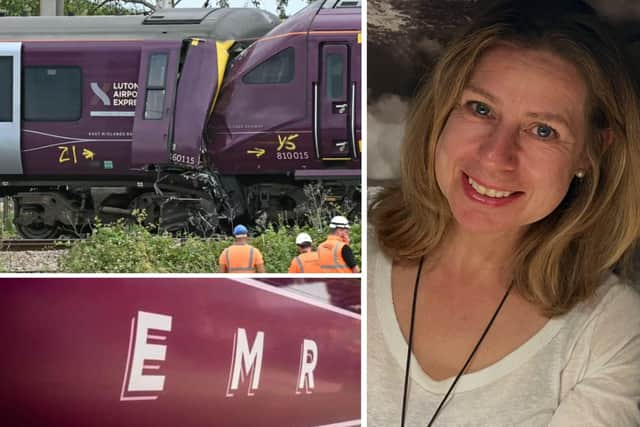

Recalling the incident, she said: “There was no indication on board that anything was about to go wrong, or had gone wrong, until out of nowhere there was a loud bang and the train came to an immediate halt.
“I thought it had been a bomb and that we needed to get off immediately.
“I was crushed in my seat, probably because the whole seating infrastructure was shifted by the impact, and when I tried to stand, I realised I couldn’t support my weight and felt the pain.
“There were lots of people screaming hysterically, which I imagine was both in pain and in panic, as there were a lot of people seriously injured in the front carriage which I was in.
“I consider myself one of the lucky ones as there were many far more badly injured than me. I was fortunate as I’d not sat in my usual seat facing forwards at the very rear of the front carriage. I know that there were multiple life-changing injuries suffered in that part of the carriage.
“Because the train was busy when I got on, I had to go further towards the centre of the front carriage and I sat in a backwards facing seat, and I had nobody sat opposite me. I think that saved me from much more serious injury.”
The driver of the train which passed through the red signal, 60-year-old Shaun Burton, was killed in the incident on June 19 at Elstow, near Bedford, with around 160 passengers also injured, some seriously.
Four months on, Mel, a retired solicitor, says she considers herself ‘one of the lucky ones’.
She suffered ‘crush injuries’ which left her with a broken leg, severe bruising and swelling, and she still experiences pain and discomfort today.
Her psychological scars are far from healed, as is the feeling that she, and other rail passengers were ‘so badly let down’.
Mel describes the immediate moments after the crash as ‘carnage’, but she kept a level head to call for emergency support, staying on a 999 call for a number of minutes to describe what had happened and what she could see.
She said: “I called 999 immediately and within five to 10 minutes paramedics and the fire service were on board helping people. I had to be helped from my seat and then off the train down a ladder to the tracks.
“It was complete carnage and the train looked like it had imploded, with seats and large suitcases over the place which had to be clambered over to treat people and to get them out.
“I knew some people were really badly injured, there was lots of blood, but I tried to block it out as I knew I couldn’t help as I was injured, and I knew there were things I didn’t want to see and couldn’t really cope with seeing. It was awful.
“One lady, who I now know was Eleanor Prior as I’ve met her since, was at the rear of our carriage and she shouted to us that she was a GP. She helped and supported many badly injured people.
“She must have seen some horrendous things and was so courageous. She’s being awarded a Pride of Britain Special Recognition award which she fully deserves as I am sure she helped save a number of passengers lives that day. I can’t thank her enough.
“You never expect to be involved in anything like this, not for a minute did I ever think I’d be in a train crash, so it’s quite difficult to comprehend.”
Mel was treated at Luton and Dunstable Hospital, where she had been taken by ambulance. She needed a boot and crutches, and also required a wheelchair in the weeks after as she regained strength in her leg.
She continues to have physiotherapy and trauma therapy to support her physical and emotional recovery.
For now, the thought of getting back on a train, as she has done hundreds of times before the crash, is something she cannot comprehend.
Mel said: “I’ve never been a nervous traveller and I’ve always felt comfortable on a train. I have three adult children who live in London, my husband works there, and much of our social life is in London.
“Prior to this I’d usually be on the train once or twice a week travelling to London, and I’ve done it for more than a decade, but I’ve not been able to face getting back on a train since, and I’m not sure when I will again.”
A recent interim report from the RAIB said the train ahead of the one Mel had been travelling on stopped unexpectedly after an automatic emergency brake application, which happened despite signals being green. Around two minutes later, a red signal was then correctly displayed to the following train, but despite being acknowledged by the driver, it went on and continued to accelerate, reaching a maximum speed of 76mph.
The driver applied the emergency brake about 200 metres before the collision, and the train struck the stationary carriages of the service ahead at 50mph.
Mel is now calling for change. She has contacted her local MP to raise concerns and hopes to join other local rail users as part of a user group in the Wellingborough area to have regular dialogue with East Midlands Railway.
Mel said: “I’m reassured that RAIB are doing a thorough and meticulous investigation but I’m concerned by the findings already. It doesn’t paint a very reassuring picture.
“The first train stopped after a warning system triggered breaks when it had actually been a green signal anyway, so something went wrong there, and then the train I was on was able to go through a red signal and speed up, without any system to override the driver given what had happened ahead.
“Added to my own experience in Bedford in June, there have been derailments in the UK this year during the heatwave, which seems to suggest an infrastructure unable to cope.
“It’s clear there is much needed investment, our railways don’t appear fit for purpose, but whether that will happen only time will tell.
“Whatever findings and recommendations come out of the investigation must be acted on by all train companies and Network Rail so that rail travel is as safe as it can be, because all of us on those two trains were badly let down.
“I also want to ensure East Midlands Railway do all they should to reassure and support passengers who feel nervous, and to demonstrate the safety features of new trains which are introduced.”
Solicitor Paul McClorry, of Hudgell Solicitors, is representing Mel and a number of other passengers injured as a result of the crash, seeking compensation from East Midlands Railway and Network Rail for the injuries and loss.
He said: “Thankfully the rail industry has provisions in place to ensure claims can be immediately started for people injured on the railways.
“Under conditions rail operators agree to as part of their operating licences, the rail industry admits liability, with exact liability of involved parties resolved at a later stage.
“With this in mind we have requested interim compensation payments for all of our clients for their losses to date, including loss of earnings, medical treatment costs, and to cover the cost of ongoing rehabilitation.
“The final RAIB report has to highlight not just what went wrong, but say what needs to change to prevent a repeat of this awful event.
“Beyond the reasons as to why the first train stopped and the second passed a signal at danger, we need full details as to why the rail network’s safety systems proved completely ineffective. At this stage, they look potentially causative of the accident.
“We live in times of advanced technology and increasing automation, and incidents like this should simply not be able to happen.”