
After new Corby childhood cancer report, North Northants Public Health chief says 'I take this seriously’
North Northants’ public health chief says she is taking seriously the latest report into cancers affecting children and young people published following investigation calls by local families.
On Thursday (October 29) North Northamptonshire Council (NNC) has shared findings of an expanded independent analysis of cancer registrations among children and young adults living in the Corby area.
The study was commissioned following requests from concerned local residents for further investigation into cancer rates in Corby.
Data used by the study again indicates childhood cancer is no more prevalent around Deene quarry than in other areas of Northamptonshire.
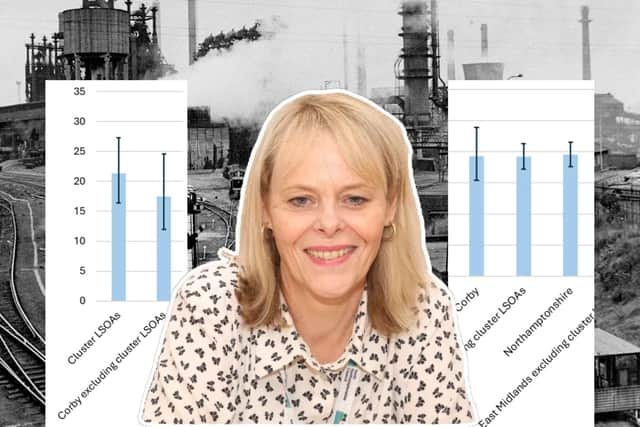

After the publication of a report looking into childhood cancer rates in Corby the Northants Telegraph (NT) has spoken to Dr Jane Bethea, Director of Public Health for North Northamptonshire.
Here’s what she had to say.
Jane Bethea: This report is building on two reports that we published at the beginning of this year. And this one, there is a longer period, 23 years. The first one was ten years and is also a wider range 0 to 25 rather than 0 to 19 as it was before – children and young adults.
We asked the National Disease Registration Service to do this, following a request from the same people that asked for the first analysis.
We asked the national experts to do that analysis, and that's what we're presenting today.
NT: So what does the new report show?
Jane Bethea: I'm hoping what the report does is reassures people. It's a longer period of time, but it's showing the same thing – that as a as a director of public health, my job is to identify an issue if one's there.
And there's nothing in this data that makes me think that cancer rates in under 25 are higher in Corby than they should be, either in the area around the (Deene) quarry or in the rest of Corby. So that's what it's showing.
I just want to be really clear that this is not analysis that we've done. It's analysis using probably the best most complete cancer data in the world. It's done in completely independently by national experts who do this all the time across the country.
NT: Has similar, statistical analysis of cancer rates in other places shown up issues in other parts of the country?
Jane Bethea: No, I haven't looked at other studies. To be honest, the analysis that we've asked that we asked us to do here had a very specific question. What is the cancer? What are the cancer rates for Corby? Can we compare that and what does it tell. If it had have been, for example, that the rates had been much higher, that would have warranted further investigation.
However, it hasn't shown that. And I think what I want people to really understand is a couple of things.
The first thing is I take this really seriously. This is a really serious issue. This is the worst possible nightmare for any parent to experience. And so every bit of information we've possibly been able to look at, we've done that. So I've done that. I've followed up the data. We've had asked the do as much as they can possibly do. We've tried to do everything we can do with the data we've got, and this is where we are now, and this is what that independent analysis is showing us.
NT: The data covers malignant cancers in children and young people up to 25. So how can you be sure that if you lived in, say, Studfall Avenue in 2002 you were diagnosed with a malignant cancer and then you moved. How does that work?
Jane Bethea: So the cancer registry is probably the best registry that there is for cancer anywhere.
So if I'm diagnosed with cancer, at the point I'm diagnosed, that goes on to the register. So somebody in your example who's in a place in 2002 would be in this data, and it's extremely complete.
(Previously) we used hospital episode statistics, which is much more complicated, really difficult to identify the individual cases. It took us a long, long time. The cancer registry is extremely clear. They have access to patient identifiable information I don't. So they can do it in a much clearer way. And their data is really complete. And that's been shown over many years over many, many different studies.
So it's a really good source of information and it's the gold standard. So I feel that those findings should give people reassurance.
NT: (Campaign solicitor) Des Collins says that he's concerned by the quality of the report. And it doesn't appear to cover all cancers reported to date. What is your response?
Jane Bethea: It's exactly the same methodology. ‘To date’ is interesting because today it wouldn't go to 2026 because that's not there there’s always a slight lag. All malignancies in that in that long list of codes would be included.
NT: Another criticism that's been raised before is that it doesn't include all areas of Corby.
Jane Bethea: That's not true. It covers all of Corby. So I think there's some misunderstanding of some of the data. But just to also point out that this is an agreed methodology. It's what happens in lots of other studies across the country, and they're the national experts.
NT: Can you explain the the wording of significant as in statistical significance?
Jane Bethea: The key thing is is you compare figures with comparison areas. So England for me would be particularly important one.
Now you always get some variation. So when you have all of these figures that you're looking at they're never going to be exactly the same. You might have 16.5. You might have 17. What you're looking for is whether that difference is big enough to be significant. And statistical testing allows you to say, well, actually this one is this one is larger or smaller.
So what I'm looking for is, is there anything that is higher or lower that actually is significant? And that is not the case in this data. So significant meaning just it means it's high. It means it's not due to chance.
So if you look at the figures, even for the ten years of data, because we also asked us to complete the data again for the last ten years, up to 25, you'll see small changes because that's normal.
What you're trying to say is, is this beyond that normal variation? Is it something that is significantly different that we need to then investigate further? It's not a number, it's a rate.
NT: Why don’t you release the raw data?
I get a lots of questions about why won't you release raw data. And I want to be really clear on that. I'm sure that your readers would be very worried if they could have their health data released to people when they asked for it. That absolutely cannot happen under the law, and I don't have it either, so I don't have the data from the NDS used for this analysis.
I don't think you would want data about you shared with people in that way. I certainly wouldn't. And I would also be insignificant trouble for doing that, because there's very important legislation around that. And I get asked that over and over again about raw data. And we've said that very clearly why we can't do that.
Part of my job is to protect people whose data is in that data set. So when we talk about really small numbers, I often won't talk about particularly small numbers because actually potentially that's identifiable. And I take that really seriously.
NT: How confident are you about this data reflecting the the truth about the cancers?
Jane Bethea: I absolutely am confident with that. And the reason I'm confident with that is from a from a scientific perspective.
NT: How solid is this data? Is it complete?
Jane Bethea: This is complete data. The methodology is sound and has been tested over a period of time. So I am very confident in what they've done.
NT: What would you say to the the families who are still convinced there is an issue is there any other data that can be used?
Jane Bethea: There isn't any. That's the reality. They can't do any more than this.
I understand what it's like when you really do think something is the case. And this is really hard. This is the hardest thing anybody's going to go through. Having a child with cancer and having that child diagnosed and treated. And sadly, some people will lose a child.
It's horrendous. And when that happens and I know this from experience, it is very, very important to you and you really, really do feel that something is the case.
And so I absolutely understand where they're coming from. I've been there, I understand it, and however all I can do is ask the questions I was asked to do this data to help people understand it. I've done everything I can do. I've gone to every length I can go to to try and answer that question, and I'm really confident with the data that we've got.
NT: Can the can it be split into cancer types? Is it possible to do the analysis for cancer types like for example brain tumours?
Jane Bethea: It is possible because they'll be coded that way. but the numbers are tiny. So when you do that it's really, really difficult to determine it.
It could be done. But at the same time, if there was something in that would have told us, because that's what that's the methodology.
I think we're at the point now where we probably don't have the ability to look at any more data. It doesn't mean I won't be interested in information that comes out. So, for example, you may have seen that there was concerns around, that there might have been ten cancers in a year. So I want to know, is there really ten cancers? And I followed that up with the hospitals. And actually there were duplicates in those cases and there weren't ten cancers in the year. I take it seriously. This is my job. If there is something there, my job is to identify it and to do something about it. I take that seriously. I am not in the business of ignoring something that's there and the rate of cancer in Corby in general. I know this is to do with children and young people.
NT: What about the cancer rates in Corby in the whole population?
So, the history of Corby as it is will mean that this will be rates of cancer will be higher and there's lots of reasons for that. Corby had the highest smoking rate of any area for quite a long time, and we know that causes cancer. So there will be those sort of historical issues.
Let's say there had have been a significant finding here. All of that would have shown us is there is a difference. It wouldn't have shown you why. That's not what this sort of analysis can do. That would be a really difficult thing, actually, to do. But this would have only been the first step in that.
NT: Will you ever allay the fears of people in Corby?
I hope we will. What we will always do is take it seriously and listen to people, because that's really important. What I hope is, is that the three reports now that we've published, I just hope that that people will read them and that they'll feel reassured about that and also feel reassured that as a council, we take this seriously as an independent director of public health, I take this seriously.
NT: So as the director of public health, are you concerned about the metals and toxins in the rivers. Are you going to be pushing for a public inquiry?
Jane Bethea: Every bit of information that comes in, we take seriously as a council and I will want to know that and I want some assurance on that. So, for example, when information is coming from the Earthwatch reports, we take that seriously and we want more information and more follow that up.
In terms of the public inquiry, as a council, it's not up to us to ask for one. People can lobby for one, and if if one was called, we would absolutely say this is all the information we have got. I know that is absolutely the case. But it would have to meet certain conditions. And what's nothing to do with us (North Northants Council) is whether those conditions are met. That's at ministerial level.
There has been concern over a number of years in Corby around whether or not there are more cases of childhood cancer than there should be, and there's been of concern about that for a really long time. And we were asked to help answer that question in 2025. What we've published today is the third report around that. It is not done by the council, it's done by national experts, independent experts and all of that together, all consistently states that there is not evidence that there is higher rates of childhood cancers in Corby than you would expect.
And so I hope that is reassuring for the people of Corby.