
£150,000 grant for team which returned extinct butterfly to Corby woodland in ‘fantastic’ conservation success story
A Butterfly Conservation team reintroducing an extinct butterfly to England have been awarded £150,000 to expand the project over the next three years.
The charity received the funding from Natural England’s Species Recovery Programme for its work to revive the Chequered Skipper using a donor population in Belgium.
The project team received confirmation of the grant while they were on their latest trip collecting butterflies in the Wallonia region, which they have since successfully released into the Rockingham Forest near Corby.
Dr Jamie Wildman, the Butterfly Conservation officer in charge of the Chequered Skipper reintroduction, said: “We are absolutely over the moon about this series of huge wins for the project.
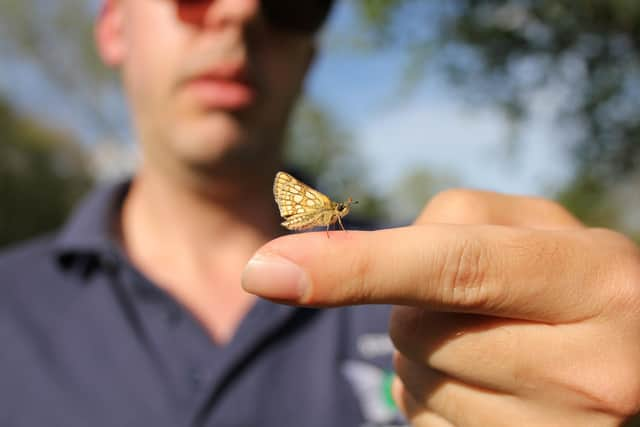

"We were in Belgium when we heard the news we had been awarded Natural England funding and it gave the trip a fantastic impetus, then we had a hugely successful two days collecting.
"It just felt like the stars had aligned so we are feeling very excited about the future."
Dr Wildman and two other officers from Butterfly Conservation went to the Wallonia region of Belgium from May 20 to 23.
Along with a team of more than 20 local helpers from the Belgian Research Institute for Nature and Forest (INBO) and with written permission from the Département de l'Étude du milieu naturel et Agricole (DEMNA), they trekked through the damp forests of the Fagne landscape armed with butterfly nets, catching Chequered Skippers which they carefully transferred to containers filled with ice blocks to put them into a state of dormancy.
On the third day, the Butterfly Conservation team set off from Belgium at 8am and reached Forestry England’s Fineshade Wood near Corby, part of the Rockingham Forest, at 5pm when the woods were bathed in the golden light of the setting sun.
Dr Wildman then delicately marked the wings of each butterfly with a red felt tip pen to help the charity's volunteers monitor the growing population.
Of the 44 females and two males the team brought back to the UK, every one took flight within seconds of being marked and disappeared into the foliage.
Dr Wildman has been involved in the reintroduction project since he joined Butterfly Conservation's first trip to Belgium in 2018.
Until the 1950s, the Chequered Skipper was still locally common in woods and fens across the East Midlands, including Rockingham Forest.
Some entomologists’ diaries describe clouds of the butterfly in some woodlands, however it began to decline as landowners changed the way they managed woodlands, planting conifer trees and stopping traditional coppice management, resulting in the loss of sunny, sheltered habitat essential to the butterfly’s survival.
Following a rapid decline, the Chequered Skipper was declared extinct in England in 1976, with small numbers surviving in Scotland. The species is still common in parts of Europe and Asia but there are worrying declines in several countries.
Butterfly Conservation started looking into reintroduction in 2010 and spent eight years assessing the feasibility.
One of the main factors that convinced the charity to attempt the project at Rockingham Forest was that landowners, including Forestry England, Natural England, and Bedfordshire, Cambridgeshire & Northamptonshire Wildlife Trust, worked with Butterfly Conservation to change how they managed the woodlands from 2015.
Butterfly Conservation has now carried out five translocations and released a total of 208 butterflies into Rockingham Forest. The butterflies have successfully reproduced in the woods, producing the first English caterpillars in decades.
On top of that, Daan Van Eenaeme from the INBO reared 38 Chequered Skipper caterpillars and pupae in captivity in Belgium which Dr Wildman has released at Fineshade after they emerged as adults.
With the new financial support from Natural England's Species Recovery Programme, the charity now plans to make another collection trip to Belgium next year, create more Chequered Skipper habitat in Rockingham Forest , and increase the amount of bugle flowers for the butterfly to nectar on.
The project will also fund a master's student at the University of Cambridge, who will spend a year studying how the butterflies are faring in different microclimates at the reintroduction sites.
Dr Wildman said: "In the UK, more than half of our native butterfly species are now in decline, but for many of them this is down to habitat loss and declining habitat quality, which we can reverse with the right management.
“We have already created broadly suitable habitat conditions for Chequered Skipper in Rockingham Forest and now, thanks to Natural England funding and the support of project partners such as Forestry England, we are able to work on the next stage – establishing self-sufficiency of the reintroduced population to ensure these beautiful insects can thrive in England once again.”
Karl Ivens, wildlife manager at Forestry England, said: "The return of the chequered skipper to Rockingham Forest is a fantastic conservation success story.
"It shows what can be achieved when expert partners, dedicated volunteers and long-term habitat management come together.
"We’re incredibly proud to be helping create the conditions for this beautiful butterfly to thrive once again in Fineshade Wood, which we look after.
"The story of the chequered skipper sits alongside many other wonderful wildlife species making a comeback in the nation's forests, which are truly places for nature to recover."