
'Nobody should live like that, nobody should die like that' - how a Corby community is coming to terms with a murder on its doorstep

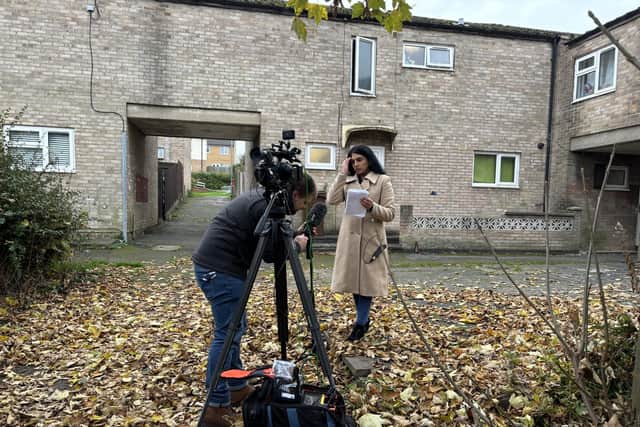
‘It’s not been a good week’, says the woman in Sturton Walk who answers her door to me, dressed all in black, before 9am on Saturday morning.
Her get-up was for a funeral she was due to attend, and she said that the goings-on next door had caused a lot of worry.

“Did I know what had happened?” she asked me. “It must be something serious.”
Several others had asked me the same question the day before.
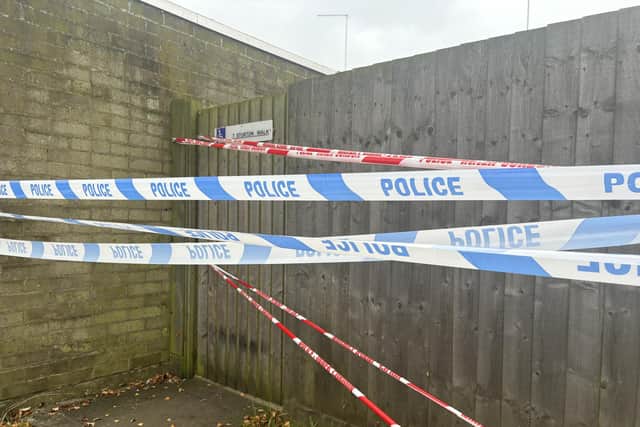
I’d asked police about the incident and I hadn’t heard back by the end of the day on Friday. A scene guard in place for a while in Corby – in any town – is not unusual.
But in the evening I had a message from a police press officer.
I’ve learned from 20 years in this job that a background briefing from the police on a Friday night is never a good thing, and the details I was given were worse than I’d feared. That night I didn’t yet know her name was Harshita Brella, though I knew what a cruel and undignified end she’d met.
But I was asked to delay my reporting because the investigation was at a critical stage, they said.
‘Do they know if he’s still in Corby?’
A journalist’s first instinct is to get news like this out there as quick as you can, but I didn’t know what repercussions a story might have. Could it have an impact on whether police were able to catch their killer?
I held back overnight. Did I do the right thing? I don’t know. I think so. Others won’t.
People were already asking questions, and despite some of the snippy answers they were getting on Corby Chats Back, I believe people do have a right to know when a major crime has happened in their area, especially when a murderer is on the loose. Curiosity is normal – our business is built on it.
At first light on Saturday morning I headed out to the Lincoln estate.
It was clear local people didn’t know what was going on. They were telling me different things. A stabbing? A teenage girl had died?
The neighbour dressed in black had heard someone leaving and the back gate slamming on Sunday night. It had stuck in her mind. It was different from the usual rowdy behaviour she’d heard through the walls.
People told me they were scared. A woman saw my notepad and stopped me. “Do you know if he’s still in Corby?”, she asked.
We know, post-Nicola Bulley, and in a climate where trust in the police is low, the potential consequences of a communications vacuum following a serious incident. A conspiracy-fuelled sewer of disinformation can easily bubble its way out of the manhole.
But as the press pack descended on our town, there were no questions allowed from reporters at a press briefing on Sunday night. Written questions since then have gone unanswered ‘for operational reasons’.
It’s not easy for the police, trying to find the right balance when there’s international arrest warrants to negotiate. We don’t know what’s going on in their incident room. But equally, people need to feel safe in their homes.
Prime suspect Pankaj Lamba, Harshita’s husband was likely on a plane by the time we even knew what had happened.
Northamptonshire Police will, I’m sure, reflect on whether their strategy to keep any information out of the public domain until four days after Harshita’s disappearance was the right one. We will know more about why they took that path when we have the benefit of hindsight.
Left behind
There were five murders in the town in the 18 months around the warm summer of 2006, when I first arrived at our Elizabeth Street office and immediately fell head over heels in love with Corby.
Since then, the town has grown faster than any other in the country, and the demographic has changed at a similar rate. The murder rate has been cut to virtually nothing.
The most recent killing in the town was Rayon Pennycook’s in 2021 when the press pack stood, socially distanced, for two days at the police cordon in Constable Road.
Before that, Thomas Gravestock was mocked and tortured to his death by Sean Doherty in 2018, just a short walk from where Harshita was killed.
All of Corby’s killings in the past decade, all equally shocking in their own ways, have happened in its most deprived ward – Kingswood and Hazel Leys. The area was identified a few years ago as a Left Behind Area. There were real efforts among community leaders to improve things, and grants were handed out, but the wholescale change that was needed has never really happened.
‘Fade into the shadows’
Corby is made up of a series of estates. If you grew up here you know where one estate starts and the next stops: if you didn’t then you’ll just have to learn.
The Lincoln is one quarter of the Radburn-style Kingswod estate, built in the 1960s and winner of architectural design awards for its exemplification of how living at close quarters could build a strong, tight-knit community.
The little square in which Harshita lived is like so many others on the Lincoln. Tightly-packed, opening out directly onto a paved area with five other front doors within just a few metres. These are the kind of houses that you can almost reach out of the window and touch the fingertips of your neighbour.
And, of course, that’s how they were designed – perhaps the earliest example of ‘15 minute cities’ where schools, green space, shops and community centres were accessible on foot for all residents. Cars were, and still are, relegated to parking areas on the edges of living spaces.
The only passing traffic here is on foot and it’s only those who’ve been here a thousand times that know all the shortcuts. So criminals were able to fade into the shadows, around a corner, out of sight of the police officers who chased them.
We could rehash the estate’s most difficult days, but people from Corby don’t need a podcast to tell them the rest is history.
Eventually in the 1980s and 90s the worst alleyways were blocked off and in the 2000s, most of Lincoln Way – the spine of the estate – was demolished for new housing.
The crime improved, though it never went away, but many of the families did. The bargain-basement house prices drew in developers from London and Houses in Multiple Occupancy sprung up on every street.
‘They’ll not get me off the Lincoln’
There are officially two HMOs in Skegness Walk, where Harshita lived, and three in Sturton Walk where police were standing guard all weekend.
There are many, many more that are unlicensed and cash-strapped North Northamptonshire Council can’t always keep up.
In 2022, this paper launched a successful campaign to curtail the numbers of them on the Kingswood and Hazel Leys estates because local people said their sense of community was being eroded by such a transient population, with too many people living in too close quarters.
Time and time again people told me they no longer knew many of their neighbours, and if they did then they didn’t know them for long before they moved on.
But there are people who have loved the Lincoln for better and for worse, and who have stuck by it.
Carolyn, who didn’t want to give her second name, is one of them. She’s been here since the good old days.
"I think there’s too many HMOs,” she said. “These houses weren’t built for eight people to be living in them.
“There aren’t as many families here now. My friends have gone.
"You can’t blame people for moving really but I’ve grown up on this estate and I’m happy to stay. They’ll not get me off the Lincoln.
"I didn’t know the poor lassie who died. I gather from my neighbour that she hadn’t lived there long at all.”
She’s been thinking about the last few weeks of Harshita’s life.
"She must have been so scared. She was no age. It’s no way to live and it’s no way to die. I just hope to God she didn’t suffer too much.”
Corby is a town which, without economic migration and immigration, would simply not exist. Almost everyone here is the child or grandchild of someone who arrived in this warm, accepting town looking for work.
Not a single person has asked me about Pankaj Lamba’s immigration status. It’s not what people care about here. It’s a stark contrast the response being pedalled on X by the Union flag profile pictures.
‘This woman has been failed’
Ward councillor Zoe McGhee, a fierce advocate of women and girls’ rights, said that what had happened was ‘terrifying’.
“Corby and North Northamptonshire is full of bright young women at the beginning of their lives,” she said.
"It strikes fear into me how quickly that can all be taken away. It appears that somewhere down the line this young woman has been failed.
"My thoughts are with Harshita’s family, but also with every woman who felt the same sickness as I did when reading this news.
“The truth is we all must do more to stop violence against women and girls. This is not just a global or a national problem, this is something that is happening right on our doorstep, in the heart of our communities and even in our homes.
"Not enough is being done to prevent this from happening again and again. I beg those in power, to do more and I will do my upmost to make that they are held to account.”
As first reported by the Northants Telegraph on Sunday, Harshita had already been identified as the victim of domestic abuse by Northamptonshire Police just two months before her death. She’d only been married a matter of months, according to reports in the national press.
A court order designed to protect her issued on September 5 had expired 28 days later. No DV charges against her husband had been laid. Perhaps the threat had been judged to have passed or perhaps there wasn’t enough evidence against him to lay a charge. We don’t know, and the police won’t answer questions on that subject right now. They’ve referred themselves to the Independent Office for Police Conduct over their previous contact with the victim.
What we do know is that Harshita’s husband has allegedly managed to kill her, get her body in a car boot, drive her to Ilford and leave her there for days before anyone noticed.
Did the authorities whose job it is to protect the victims of domestic violence services get it right this time? Clearly, and catastrophically, not. But domestic violence is complex. Victims go back. Sometimes they don’t even recognise themselves as victims.
Corby MP Lee Barron said he’ll raise Harshita’s case at the highest level should it become necessary.
"If questions need raising I stand ready to take the issues up directly with ministers,” he said.
"Let us hope that the efforts to find the perpetrator are successful and any outcomes from the voluntary referral to the Independent Office for Police Conduct can be addressed once the investigation is completed.”
‘Harshita’s murder is appalling’
Northamptonshire Police are now under intense pressure to arrest Pankaj Lamba, who has fled abroad. Police won’t say where they think he’s gone.
Women’s campaigners last night told The Independent they believed there’d been a missed opportunity by police to save Harshita.
Sixty officers are combing through footage. Our reporter watched on Sunday as every door in the immediate area was visited by police carrying out door-to-door enquiries.
There’s no doubt every resource available is being thrown at this.
Last night, crime commissioner Danielle Stone, whose job it is to hold her police force to account, said: “The murder of Harshita Brella is appalling and while I cannot comment on her case specifically, I know that Northamptonshire Police will be doing everything possible to find out what has happened to her and bring the perpetrator to justice.
“What I can promise is that the safety of women is at the heart of my draft public safety plan for the county. I want Northamptonshire to be at the leading edge of collaboration to improve the safety of women, and to better protect, serve and safeguard those who may be the victims of domestic abuse.”
- If you have any information that could help police track Harshita’s killer you can contact the incident room by calling 101, quoting incident number Operation Westcott.
Alternatively information can be submitted via the online public portal at www.mipp.police.uk or by call Crimestoppers, in confidence, on 0800 555111.