
Sales rocket after history buffs attend Desborough book launch
A new Desborough history book, launched in August, has taken the town by storm and local interest has rocketed.
Sue Purcell and Ron Hanson, the authors, said, “We are delighted to say that soaring sales have taken us quite by surprise, especially as the book was written with the intention of only selling locally. We have received some great reviews, too!”
The hardback cover of the tome is a vivid blue colour, in a soft touch quality, adorned with sketches of old Desborough by John Blackwell, a local artist. The pages are also soft touch, providing a comfortable read, and, I am told, it does look rather handsome on the bookshelf, or on a coffee table. The History & Development of Desborough – A North Northamptonshire Community is available to buy at Desborough Heritage Centre, who receive a small donation from the authors for every book sold.
Titled The History & Development of Desborough – A North Northamptonshire Community, by Sue Purcell and Ron Hanson, this new book made its initial appearance on Saturday, August 9, at Desborough’s VJ Day: Picnic in the Park celebration where families congregated together to enjoy the warm sunshine and entertainments laid on by the Town Council.Amongst the many visitors to the stall was Kettering MP, Rosie Wrighting, who made a surprise visit and was attracted to purchase a copy for the coffee table in her office, where visitors could browse the interesting volume about a small town in her constituency.
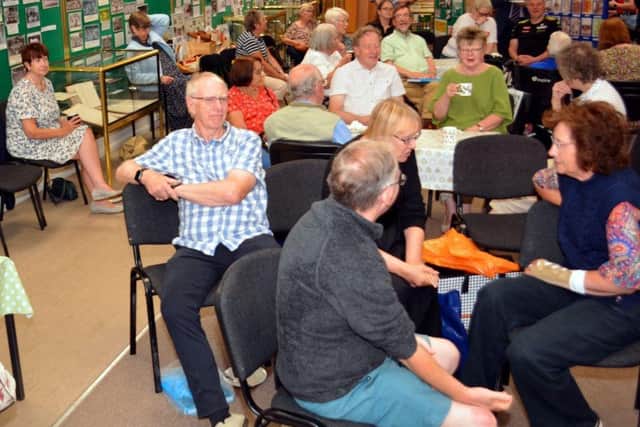

The official book launch took place at Desborough Heritage Centre the following week, on Saturday, August 16, when a large number of people attended to buy a copy and show their support for the handsome new edition, portraying Desborough’s history over the past 250-300 years, a compilation of information gathered from the public domain using genealogical resources, historical trade directories, newspaper articles from the 18th century to present, and other reliable sources, each being researched thoroughly for authenticity.
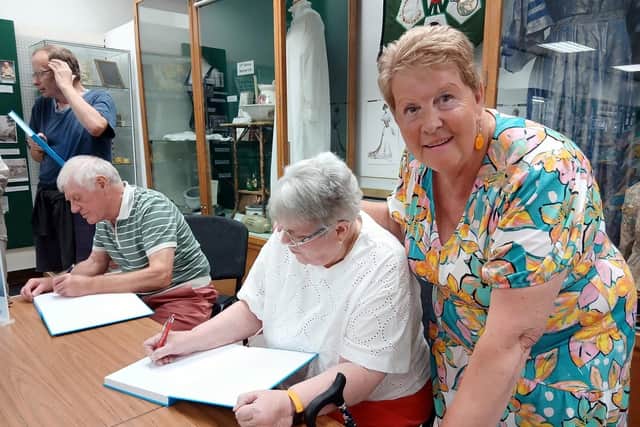
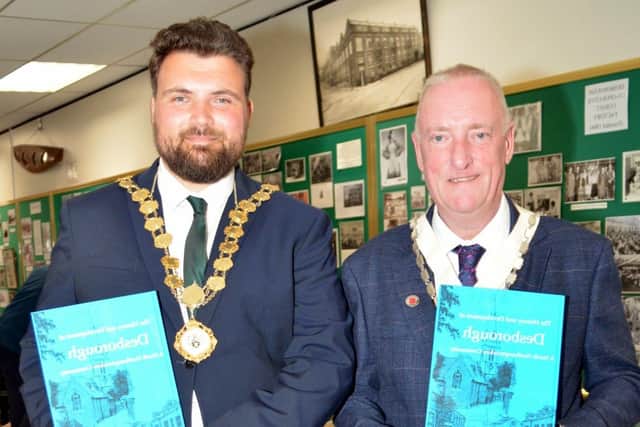
Amongst those who enjoyed the hospitality of the authors, including tea and cake, courtesy of the volunteers of the Heritage Centre, were the Mayors of Desborough and Kettering, Cllrs. Bill McElhinney and Ben Jameson; representatives of NNC Heritage & Culture, Matt Taylor and Billy Dalziel; local businesses, Dunkelman & Son Ltd., who provided a fine display of their products for historical interest, and Lee-Dickens Ltd.; President of Kettering Civic Society, Richard Barnwell; Statistician at Dept. for Communities and Local Government, Andrew Presland; and founding chair of Desborough Civic Society and curator of Desborough Heritage Centre, Belinda Humfrey, who offered a few words about the Heritage Centre.
In addition, there were numerous members of Desborough Civic Society and volunteers of the Heritage Centre, not forgetting friends and family of the authors, all contributing to a highly successful and enjoyable afternoon to discuss the attributes of the new history book, presented by the authors to the community of Desborough.
To provide readers with a flavour of The History & Development of Desborough – A North Northamptonshire Community, and not to deprive potential purchasers of the joy of opening their new book for the first time, and the smell that emanates therefrom, the easy-read book begins with a detailed introduction and good index as a finding tool.
The story begins with the well-documented sale of the Manor of Desborough by the Poulton family in the early 1700s and goes on to provide details of the life and times of the agricultural village, entering the Industrial Revolution and describing how employment came to Desborough, predominantly through wealthy industrialists in search of cheap labour. Of particular interest is a well-documented walking tour of Desborough taken on census night, in 1841, on the night of Rowell Fair. By 1855, the village had developed rapidly, even more so with the coming of the railway, bringing further employment, transportation and communication with other parts of the country.
Industries flourished and people from other areas came to Desborough in search of work, increasing the population and the demand for housing and facilities. New people, new ideas and technological advancement brought development, and the town exuded a never-before-experienced affluence.
Later, the town, like many others, was blighted by the influence of war, but out of which developed a new phase of community life. Old houses were demolished and there was a new hunger to replace them with modern ones. A by-pass was constructed, and, with it, Desborough entered a new period of development, covered by the book right up to the present, some 300 years after the Poulton’s left a near-derelict agricultural community of less than 800 people, to release themselves from debt and find a new life in London.
And so it was that, through all these changes, Desborough community worked and toiled to improve their situation, with a certain pride in their achievements. The book follows many of the people who contributed to the community we know today, many of them with ancestors of the same name, who lived here for hundreds of years, ploughing, sowing and tilling the land.
It follows the changes to personal circumstances, successes and failures, good times and bad. And, as a little extra, interspersed through the chapters, there are imaginative tales providing atmosphere and credence to fictional events, incorporating non-fictional Desborough characters, written by Ron Hanson. The rest, as they say, is for the reader to discover.