
Mystery of Higham Ferrers' missing Medieval castle finally revealed
The mystery of what Higham’s missing medieval – and royal - castle probably looked like appears to have been solved.
It follows an intensive 10-month geophysical survey when a team of archaeologists used a combination of three different research methods to help discover some of the mysteries of the castle and to find out what it might have looked like.
Speaking when the results of the research were recently revealed to guests in the town’s historic Chichele College, Olwen Mayes, chairman of the Higham Ferrers Archaeological and Research Society (HiFARS), said: “We certainly discovered more than we had hoped to find.”
She marked the occasion by commissioning her cousin Wendy Cooper to make a special castle-shaped cake.
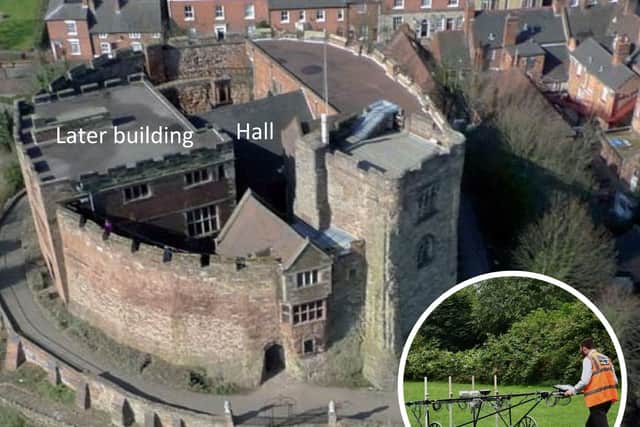

The stone-built Higham Ferrers castle was in its heyday in the Middle Ages when it served as the headquarters of the Northamptonshire landholdings of the Duchy of Lancaster, and then from 1399, was owned by the Crown.
But it was demolished in the early 16th Century when Henry VIII granted the owner, Sir Richard Wingfield, permission to dismantle the castle and take materials from the site to build the Tudor wing at Kimbolton Castle.
The HiFARS committee made several attempts to secure funding to undertake geophysical surveys of the castle site to discover what the findings might reveal – and then in early 2024 they had some good news.
After a team from the Museum of London Archaeology (MoLA) said they were interested in carrying out a survey, Stephen Parry, a director of his company, Finham Heritage, secured a generous grant from the Castle Studies Trust to carry out the geophysical surveys.
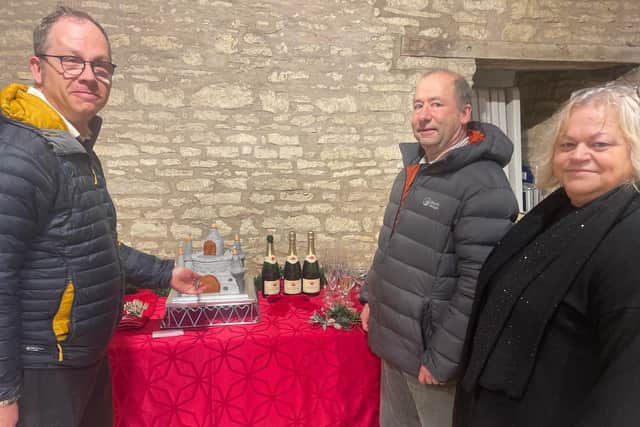
With other funding going on for several years, further grants were received from Cllr Chris O`Rourke’s mayoral fund at Higham Ferrers Town Council and the (former) East Northamptonshire Council empowerment fund of Cllr Bert Jackson and Tony and Jennifer Norman, enabling archaeologists Stephen Parry, as well as John Walford and Graham Arkley (both of MoLA), to undertake the project, supported by HiFARS members.
As the site is a scheduled ancient monument, a licence had to be granted from Historic England for the work to take place.
The survey covered various land parcels to the north of St Mary’s Church.
The team used ground penetrating radar in a bid to locate the main buildings, a magnetometer to identify any substantial ditches (moats) around the castle as well as the remains of any walls, hearths and pits.
They also undertook an earth resistivity survey – with the support of HiFARS members – to provide further detailed information about any buried wall foundations or other structural remains.
Ancient accounts told that the castle had been substantial, boasting two baileys (courtyards), each enclosed with defensive stone curtain walls.
The survey revealed that the foundations of a curtain wall and other buildings of the inner bailey still survive under the garden of the Green Dragon Hotel, as revealed by Stephen Parry in the Castle Studies Trust Blog.
He said: “Other building remains survive to the north, within the likely extent of the outer bailey.
“The foundations of a square gatehouse, measuring 6m by 5m, were revealed across the line of the curtain wall and would have provided access from the outer bailey.
“Inside the curtain wall, the foundations of a large rectangular building measuring 12m by 7m may have been the great hall, which documentary sources indicate was rebuilt after a fire in 1409-1410.
"Other foundations within the curtain wall suggest the presence of other buildings that may have predated the fire.”
In view of the findings and documentary evidence, the research suggests that Higham Ferrers Castle may have looked like Tamworth Castle in Staffordshire.
Speaking in an interview, Stephen Parry explained: “The important distinction is that Tamworth Castle is on a high mound, whereas Higham Ferrers Castle was not on a hill, but surrounded by an earthen bank.”
To follow the analogy with Tamworth to its conclusion, Higham Ferrers castle should include the King and Queen’s chambers, chapel and kitchen.
However, as yet, no structures have been identified.
Olwen Mayes said that she never expected that the survey findings would be the size and shape that they were.
And looking ahead, she said that the hope is to eventually get funding for excavation work.