
Kettering 'pack of cards' builder found guilty of health and safety breaches that risk lives of children and adults
The builder of an illegal, planning permission-breaking Kettering six-storey apartment block, was found guilty at Northampton Magistrates Court yesterday (June 23) of six charges of breaching health and safety regulations.
Marcus Fielding, sole director and sole employee of company Michigan Construction Ltd, was told by District Judge Amar Mehta to expect a sentence upwards of 18 months – to be handed down at Northampton Crown Court in August.
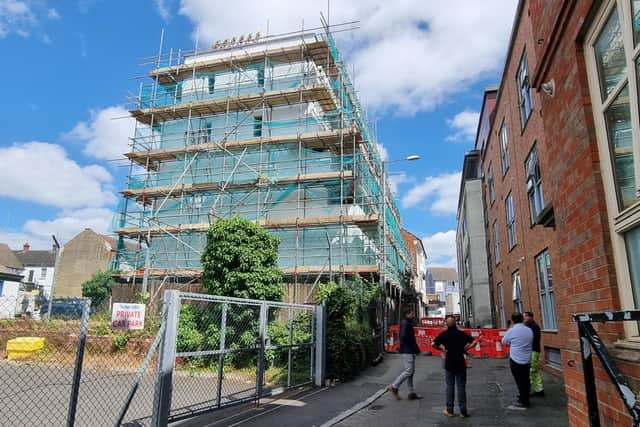
The prosecution brought by the Health and Safety Executive (HSE) centred on a block of flats in Job’s Yard, built and lived in by Fielding – over allegations that he failed to take steps to prevent danger to the public through the potential collapse of an unstable building – Job’s Yard – and its potential structural collapse.
It was also alleged that he ignored parts of a prohibition notice that forced him to take steps to ensure scaffolding outside the building was safe and was prevented from collapsing.


As on the opening day of the trial, expert witnesses from the construction industry and Kettering residents and neighbours were called to the stand.
Day two carried on in similar style, when Kettering residents, council staff and HSE representatives recalled how they had seen Fielding working on the six-storey flats – after he had been ordered to stop, sometimes using scaffolding that he claimed was ‘booby trapped’.
The first witness of the day who works nearby, said that she too had seen Mr Fielding on the scaffolding but also recalled one day when she had seen two people she thought were young teenagers going into the Job’s Yard site. They were carrying building materials from a van into the building site, they were with Mr Fielding and he was doing the same.
She said that two other people had called the police.

After saying that it was ‘just not true’ he had been with two children, he was pressed by prosecutor Tom Daniel and Judge Mehta. Fielding then explained he had ‘sponsored’ nine Ukrainian refugees admitting that the two people were an ‘adult and a child’.
He said: “There was one child who was helping for 10 to 15 minutes. It was just out of childish enthusiasm to help by carrying blocks. The child didn’t go into the building."
Second witness was chartered structural engineer and expert witness David Smith.
Once again as in the previous day, Fielding – representing himself – was asked if he had read the court papers that had been sent to him in April.
Leafing through at least five arch lever files filled with documents, Fielding told the judge he’d only received the documents ‘five minutes ago’ and admitted he hadn’t read the updated visual and structural assessment report prepared for the criminal proceedings by Mr Smith.
In the witness box, Mr Smith, who had already given evidence in a civil High Court case in relation to Job’s Yard, was accused by Fielding of only spending ‘two minutes on site’ back in 2022.
But Mr Smith firmly reassured the builder he had visited the site twice, once for an hour-and-a-half and on another occasion for 40 minutes. accompanied by a colleague to log all the defects in the building and the report was a structural report.
Fielding asked Mr Smith if in his opinion, could any building – including Job’s Yard – be ‘made good with steel’.
Mr Smith replied a missing lintel or a missing weight-bearing wall could be remedied with a steel beam but the structure Mr Fielding had built was beyond that.
He said: “When you get something so inherently incorrect, this is a major issue. This is not simply ‘sticking a steel beam in’.”
Mr Smith catalogued faults with the width of the foundations, with load pressures designed for four storeys not six, issues that could not be addressed even with pile driving further foundations.
Listing the issues, he said: “The blocks were not safe, all the loads on the wall were not safe. Blocks were too weak for the load. It’s not only that, it’s also the way the blocks were constructed. The block work had a vertical joint in it. They should be tied together. Brickwork on the staircase was not properly aligned and smashed the brickwork below. There are issues with the floor joists – you can’t modify them – they should sit firmly and squarely. There need to be vertical and horizontal ties so it doesn’t collapse like a pack of cards.”
Judge Mehta, when told the loads on the building, calculated the overload on the building would be approximately 181 per cent.
Mr Smith cited the case of Ronan Point tower block, that partially collapsed in 1968, impacting Building Regulations to prevent ‘disproportionate collapse’ saying a similar collapse could take place in Job’s Yard if there was a gas explosion, fire or flooding from pipes and there could be further dangers from utilities within the building due to its poor construction. The danger even greater when adding the load from furniture and people.
He said: “If there’s a gas explosion, it’s going to cause everything to collapse. It is unsafe.
"In the worst case scenario, if they were let or sold, and you get excessive settlement of the foundations, all of these things could happen – it collapses, or sets on fire, or people are electrocuted. Tenants are sitting ducks – it’s only a matter of time. Sometimes a building can go (collapse) overnight.”
Fielding dismissed the report as being four-years-old and since it was first written, him and his company had added ‘extensive steel work to the building’.
He repeated his claim he had kept the site in a ‘clean and safe condition’ and he was only doing remedial works to ‘address asymmetric loading’. He then invited Judge Mehta to visit the site to see the foundations for himself. The judge firmly replied ‘no’.
Fielding, referring to himself in the third person, said: “We are of the opinion that if the building is unsafe, then we should be able to repair it. No decision should be made before a structural report.
"They (the HSE) provide no exit route and would leave a building abandoned in the town centre. This was originally designed as a project to be a template like a city garden. That will not happen.”
Once again on the stand, prosecutor Tom Daniel quizzed Fielding on his behaviour following the prohibition notice being served on him stopping him from working on the site.
Mr Daniel said: “Workforce on the site were at severe risk of serious injury or fatality. Why were you up there painting?”
Fielding shrugged and meekly replied ‘because it looked scruffy,’ adding he was only doing essential remedial works including on the scaffolding.
Stating he always exercised ‘good judgement’, Fielding was taken to task by Mr Daniel: “Do you think it’s ‘good judgement’ to allow a child to enter a site, after the HSE said it wasn’t safe? Why didn’t you tell that child’s mother you had been told the building was unsafe?”
He said: “I can’t control a 10-year-old child who doesn’t speak English.”
Questioned about angle-grinding scaffolding he was sat on, without a harness, Fielding declared ‘that is perfectly safe’.
In a more reflective tone, he said to the court: “If you want to keep the building, keep the building. If you want to knock it down, knock it down. The building can come down, but we don’t have funds.”
But the court then heard demolition experts assigned by North Northants Council trying to gain access to the site had been put off by Fielding ‘dragging his feet’ twice – they had to get a warrant.
In his closing statement, he once again apologised to the neighbours.
He said: “Fortunately no-one has been hurt or injured and hopefully we can find a way forward.”
Giving his judgement without a pause in proceedings, Judge Mehta said: “I accept the evidence of Mr Smith in its entirety. He’s an expert of 35 yeas. He comes to the conclusion that it is the building that is dangerous and could collapse at any time if there’s a load on it.
"It has been shown to me that Mr Fielding is carrying on work on that building.
“What is more serious, he was carrying out that work in the presence of a child and didn’t tell the child’s mother there was a prohibition order on that building. He put that child at risk of serious injury.
"He was carrying out work in breach of the prohibition notice. There was risk to the general public going about their business in the area.
"More aggravating – there were buildings next door used by young children.
"It could have collapsed at any time.
"He (Fielding) wilfully ignored all of those things and he carried on doing what he wanted in that building. His behaviour was to prevent the demolition and frustrate proceedings. I reject his evidence in its entirety.
"I find him guilty on all counts and all counts of his company of which he is director. The sentence can only be upwards of 18 months.”
After Fielding was told to appear at Northampton Crown Court in August to be sentenced, Fielding once again said: “I prevented accidents on site, I have taken steps to prevent accidents to the public. The building is safe.”