
East Midlands Ambulance Service declares critical incident after period of sustained pressure
East Midlands Ambulance Service NHS Trust (EMAS), which covers Northamptonshire, declared a critical incident on Saturday after period of ‘sustained pressure’.
The declaration made at 2.30pm on Saturday (June 27) followed a period of sustained ‘significant’ pressure on ambulance services across the East Midlands.
In response to the sustained pressures across the NHS and ambulance services, EMAS had escalated to Resource Escalation Action Plan (REAP) Level 4 last week as the intense heatwave began.
REAP Level 4 is the highest level of ambulance service escalation and indicates there is a risk of ‘service failure’ unless immediate action is taken.
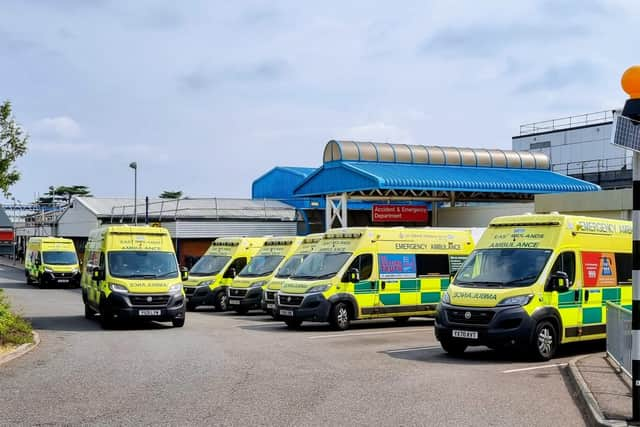

A spokesman for EMAS said: “Over the past 24 hours, EMAS has experienced a significant increase in demand for its services, alongside ongoing pressure within the wider NHS, and the additional challenges created by this week’s extreme heat. These factors have combined to create a situation that has led to this level of escalation.
“In response, EMAS continues to work closely with NHS partners to help reduce risk to patients and maintain emergency ambulance availability.”
Last week one EMAS staff member contacted this paper to describe the pressures of working in an ambulance during the heatwave, without air conditioning, trying to keep a 92-year-old patient cool by dabbing their face with water.
They said: “Air con is a must not only for staff but for patients with temperatures. At then end of the day they are a mobile greenhouses without.”
Actions taken by the service included working with hospitals in the area to support the ‘timely handover of patients’ so ambulance crews could return to responding to 999 calls.
The service also worked with healthcare providers to direct patients to the most ‘appropriate care for their needs’ when not a life-threatening emergency. Calls responses were prioritised to the most life-threatening and serious incidents.
The spokesman added: “Like many across the NHS, EMAS colleagues have been working tirelessly to respond to patient need. All available internal actions to mitigate risk have been taken. Therefore, a critical incident has been declared to secure additional support and help reduce the risk of avoidable patient harm. “The public is asked to help by using NHS services wisely and by taking regular medication to manage long-term conditions.
“If your illness or injury is not immediately life-threatening, please seek alternative care via a pharmacy, urgent treatment centre, or general practitioner (including out of hours services) – visit the NHS website for services near you. “Given the additional weather-related pressures being responded to, please act responsibly and do not take unnecessary risks.”
The Emergency Preparedness Resilience and Response framework describes a critical incident as ‘any localised incident where the level of disruption results in the organisation temporarily or permanently losing its ability to deliver critical services, patients may have been harmed or the environment is not safe requiring special measures and support from other agencies, to restore normal functions’.
EMAS formally stood down the critical incident today (Monday, June 29). Strategic Commander Craig Whyles said: “The incredible hard work of our staff, leaders and volunteers, alongside actions from our partners, means that the number of patients awaiting an emergency ambulance response has reduced. Thank you to everyone who has worked tirelessly this weekend to manage this pressure. “We continue to see high levels of demand for our service, and we remain at level 4 of our Resource Escalation Action Plan (REAP) to reflect this. “EMAS will maintain strong oversight of our performance and activity. We continue to work closely with partners to ensure ambulance crews can respond to patients waiting for an emergency 999 response as quickly as possible. “Members of the public - please use all NHS services wisely. The ambulance service is for life-threatening emergencies. For urgent needs, please use NHS 111 or seek help from a pharmacy, urgent treatment centre, or your GP.”
EMAS covers six counties: Northamptonshire, Derbyshire, Leicestershire, Lincolnshire, Nottinghamshire and Rutland.