
Day one of trial of Northamptonshire hunt staff charged with hunting and killing hare with hounds near Kettering
Staff of a Northamptonshire hunt have appeared in court charged with hunting a wild mammal with dogs on day one of a trial in front of a district judge.
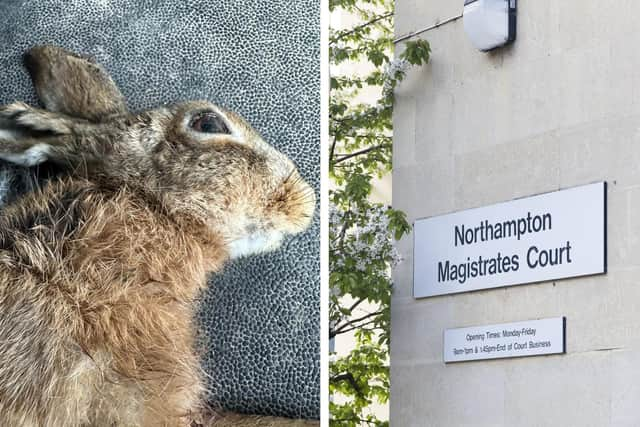
Pipewell Foot Beagles Ltd’s huntsman Philip Anthony Saunders, 45, of Irchester, and whipper in, Rachael Victoria Lenton, 42, of Raunds, appeared before Judge Amar Mehta at Northampton Magistrates’ Court on Monday (February 16) after the death of a hare on the Boughton estate near Kettering on January 25, last year.
The pair had pleaded not guilty at a previous hearing in July 2025 – the company is also facing the same charge under Section 1 of the Hunting Act 2005.
Key witness, retired police officer and amateur wildlife photographer, Emma Reed had filmed the incident while taking pictures of wildlife on the Boughton Estate.

Prosecuting counsel Neil Sands and defence solicitor Stephen Welford questioned Ms Reed for more than an hour.
The court studied three video clips of Saunders and Lenton in fields near Weekley taken by Ms Reed, who talked through the incident.
Ms Reed had switched from taking stills to video as she hunkered down in a small copse in the estate close to a public footpath on the afternoon of Saturday, January 25.
On the clips, Saunders and Lenton can be seen with the pack of 24 beagles or hounds – the camera following them across two fields.
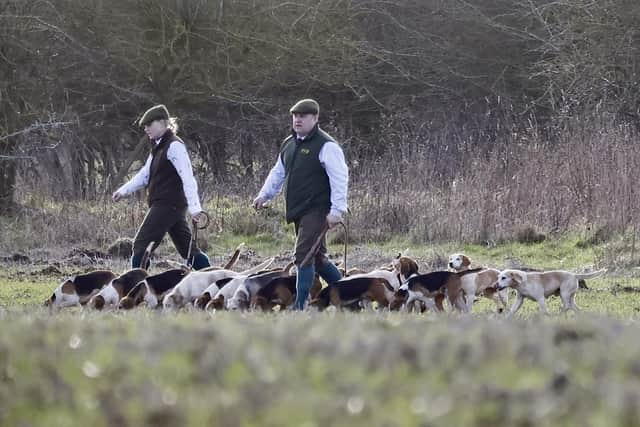
Accompanied by the two defendants, the pack of hounds becomes excited after picking up a scent, eventually forming a frenzied, noisy huddle around something on the ground, before they move on. That something was a brown hare – a protected species that had been resting in a ‘form’, a hollow in the middle of an arable field.
In the witness box, Ms Reed confirmed her 25-year police career including time as a dog handler. When asked by Mr Sands if she was a hunt saboteur she said ‘no I am not’.
Going over the events of the day, Ms Reed recalled how she had been taking photos of wildlife when she heard a hunting horn. A little time later the defendants came into view with a pack of hounds.
She said: “I thought the pack was very well controlled. They were in possession of whips and a hunting horn.”
Ms Reed confirmed she thought the hounds were hunting and searching, walking up the field in a ‘co-ordinated way’.
As well as visuals, the sounds of a hunting horn and voice commands can be heard on the video.
Ms Reed told the court, after the hounds surrounded what she later discovered was the hare, she heard Mr Saunders ‘very very clearly’ say “Go on after it, go on after it, go after it, go after it”.
She said: “Those were the commands while the hounds had the hare, while they were pulling it apart, while the hare was being attacked.”
When asked if either defendant had stopped the hare from being attacked, or did anything to protect the animal, Ms Reed said ‘no’ and that Saunders had encouraged the pack.
She said: “There were only verbal commands of encouragement. It was definitely intentional and deliberate.”
During his cross-examination, defence solicitor Stephen Welford suggested Ms Reed had misheard the commands, saying they had been ‘get on back to him’ and ‘leave him’.
Ms Reed disputed the suggestion – saying ‘absolutely not’ – disagreeing with the suggestion that ‘nothing could have been done to prevent the death of the hare’.
She said: “I’m 1,000 per cent sure it was ‘go on after it, go on after it, go after it, go after it’.”
Next on the stand were two members of staff from Boughton Estate – estate manager Sam Rees and head of security George Whittaker.
They confirmed Pipewell Foot Beagles were allowed to use the the estate for trail hunting and exercising the hounds. The hunt staff had sought, and been granted, permission for ‘simply for exercising’ ahead of January 25.
Brought in to share his specialist knowledge of commands and hunting horns was hunt expert Stewart Scull.
Mr Scull took the district judge Mehta through the video, explaining the sounds and interpreting the orders given to the hounds, the dogs’ behaviour and methods for creating artificial scent trails, as well as hunt jargon.
Watching the footage, Mr Scull said Saunders could be heard ‘burring’ and saying ‘hike hike’, encouraging sounds for the hounds.
When asked by prosecuting counsel Mr Sands if he thought the killing of the hare was accidental or intentional, Mr Scull replied firmly, “intentional”.
Defence solicitor Mr Welford suggested to Mr Scull that it was not ‘hike, hike’ but ‘bike, bike’ a corruption of ‘back, back’ and that Saunders was calling the hounds off the hare. The hunting horn blown once was to ‘keep the hounds focused’ – two blasts was ‘a drawing call’.
Mr Scull said: “I maintain I heard ‘hike’. I can only tell you what I hear ‘get on after it, get on after it’."
When prosecutor Mr Sands asked Mr Scull if he had any doubts that the hare was hunted by the hounds, he said ‘no’.
Final witness on the first day of the trial was defendant Philip Saunders. He explained he had been volunteering as the huntsman for two seasons, training the hounds every Saturday.
Under questioning he said on the day in question, he and Lenton had been using the hounds to follow a trail. With them had been another whipper-in and hunt followers – all on foot.
Once again Saunders said that the audio from the footage was ‘bike bike, bike’ but he couldn’t recall any other verbal commands.
Mr Sands said: “Were you using any verbal commands or horn calls in the pursuit of a hare?
“No, no,” said Saunders.
"Did you see that hare being pursued? asked Mr Sands.
"No!” said Saunders.
He then said the person talking on the video was Lenton who had said ‘get back to him’ twice to the hounds.
After asking why the trails used for hunting used a substance that contained ‘essence of rabbit’, Saunders said it had been decided prior to him taking over the pack’s management.
Mr Sands said: “What you do is hunt live animals and that’s what happened here.”
Questioning why Saunders had not passed on the names of the 10 hunt followers to support his account of the events or the identities of the trail layers to the police, the defendant denied once again he had been hunting the hare.
Mr Sands said: “You did not see the dog with that piece of hare in its mouth?” – “No”, said Saunders.
Again and again Mr Sands asked Saunders if he had been hunting the hare “ You did not see the dogs tearing it apart? – “No”, said Saunders once again.
Mr Sands continued: “You knew exactly what was happening, you hunted that hare.” – “No! No!” said Saunders.
The trial continues on Tuesday (February 17).