
Under-threat Wellingborough trees to stay as council rejects claim for subsidence
A report found the property's foundations were subject to seasonal changes in the clay sub-soil
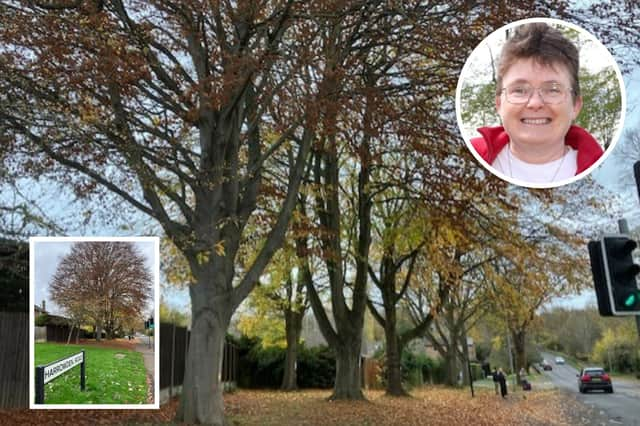
Wellingborough trees campaigners have welcomed a council decision to reject a proposal to remove four mature beech trees in Harrowden Road.
The trees were threatened because insurers claimed that subsidence affecting an extension to a property in Roche Way was being caused by the trees and they must be felled.
North Northants Council (NNC) initially agreed and were set to fell the trees until legal intervention by Wellingborough Walks Action Group (WWAG)’s solicitors using detailed evidence obtained by the group.

The independent reports, including from a surveyor and arboriculturist, confirmed that the trees were not the likely cause of the subsidence and felling them would not resolve the issue.
Marion Turner-Hawes, spokesman for WWAG, said: “We are delighted with the result. We hope that today’s decision will empower other communities and councils fighting to save trees threatened by insurance companies and provides a positive example of how the duty to consult and robust evidence can be used to prevent the senseless felling of much-valued mature trees.
“This case shows what an evidence-based approach led by a local council, with involvement from the local community can achieve. WWAG looks forward to working with NNC in the future to protect Wellingborough’s natural assets.”
The decision to fell the trees was dealt with NNC’s shared insurance service team based at Cambridgeshire County Council.
It was only after WWAG questioned the proposal that relied on evidence from the insurance company, the group had commissioned an independent strutural report, that the council gathered its own independent expert evidence, providing a clear evidence base for retaining the trees.
NNC’s report found that the whole of the house in Roche Way appeared to be subject to seasonal changes in the clay sub-soil.
The report stated: “Removing the trees would not solve the problem as the foundation to the porch is quite shallow and would always move up and down during season fluctuations in clay moisture content.
“The permanent solution would be to either underpin or rebuild the porch extension on an adequate foundation with a movement joint where it abuts the original property.”
Council findings match the conclusion by WWAG’s structural engineer obtained as part of a consultation in February this year.
Cllr Chris McGiffen, the council’s executive member for highways, waste and environment, said: “North Northamptonshire Council undertook a consultation in early 2026 on the proposed removal of four street trees on Harrowden Road, Wellingborough which relates to a property in Roche Way, Wellingborough.
“There was a concern that healthy trees could be lost based on an external report which was why an independent structural survey was also undertaken by the council. The results of this, alongside the consultation feedback, have assisted with the decision-making process.
“It is now recommended that the trees remain in place as it has been concluded that the removal of the trees would not solve the wider issue of subsidence damage to the nearby private property.
“This is a welcome result and I would like to thank both council officers and members of the Wellingborough Walks Action Group for their support to achieve this outcome.”
Hailed as a ‘landmark decision’ by WWAG, the group hopes the decision will provide further evidence for the owners of the affected property to draw on to ensure their insurers provide ‘appropriate resolution’ of the subsidence affecting their property.
The WWAG Committee said: “Thanks to everyone that helped save the trees, including those that took the time to write in and have their say, the professionals that supported us, and colleagues at NNC for ultimately being open to finding a better and fairer way to deal with this case, and hopefully others like it.
“We hope new learning about how such cases should be managed by NNC in the future has also been achieved, which could save the council thousands in dealing with erroneous compensation claims, while also safeguarding the town’s trees.”