
Closure orders slapped on three Wellingborough town centre mini-marts
The orders were imposed following applications under the Anti-social Behaviour, Crime and Policing Act 2014, citing nuisance or disorder at the premises
Three Wellingborough mini-markets have been issued with closure orders following a hearing at Wellingborough Magistrates Court yesterday (Tuesday, November 17).
Owners of Euro Maxx at 14, Victoria Road, Kubus Market at 34 Market Street and Monopol at 29a Market Street were all ordered to appear before the court following a joint investigation led by Northants Police and North Northants Council Trading Standards department.
The application was made under section 80 of the Anti-social Behaviour, Crime and Policing Act 2014.
Evidence read out to the court said that raids carried out at the premises had uncovered illegal stashes of tobacco, vapes, cigarettes and some illegal toys - some stashed in concealment ‘hides’.
First before the court was to be Mr Dashti Gharib, owner of Euro Maxx, who if he had been present could have contested the closure order of his Victoria Road store.
But Mr Gharib is on a family trip to Iran until January.


Prosecuting solicitor Ellis Butler told the court that a raid on the premises by Northants Police and Trading Standards had found 30,560 illegal cigarettes, 7.9kgs of illegal hand-rolling tobacco, more than 800 illegal vapes.
The police had also discovered concealment hides in which were a ‘substantial quantity of illegal tobacco and vapes’.
Neighbouring shopkeepers had said they couldn’t compete with the prices offered because of the illegal products didn’t pay duty leading to a ‘substantial loss of revenue’.
Magistrates granted the three-month closure order saying it was a ‘necessary and proportionate’ response to the behaviour and nuisance caused by the premises. In his absence, Mr Gharib was ordered to pay costs of £210.
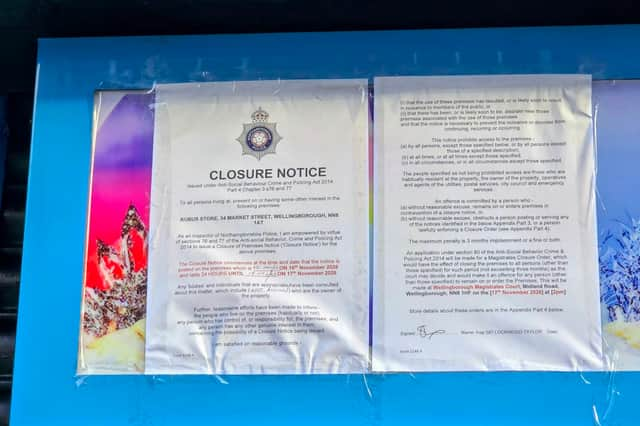
Next in court was Alan Jamal, owner of Kubus store in Market Street whose shop had been closed by a court order on Monday (November 16).
An order attached to the outside of his Market Street shop stated: “The use of these premises has resulted, or is likely soon to result, in nuisance to members of the public, or that there has been, or is likely soon to be, disorder near those premises associated with the use of those premises and that the notice is necessary to prevent the nuisance or disorder from continuing, recurring or occurring.”
In court to contest the closure order, Mr Jamal, indicated that he would need a Sorani interpreter (Kurdish).
To keep the closure order in place until an adjourned hearing, a 14-day closure order extension was granted. He will next appear on December 1.
Mr Jamal was told by the magistrates: “Until that time, the shop stays shut. The shop cannot be opened until you come back to court.”
Last on the stand was Shekho Ibrahi, owner of Monopol in Market Street.
Saying he would oppose the closure order, he said: “I will fight for my shop.”
Prosecutor Mr Butler told the court the closure order had been put in place due to nuisance and disorder.
He said: “Given that when the police visited in order to serve the order, they found at the rear of the store there were two purpose-built sophisticated hides. The closure order should be in force.”
Mr Ibrahim disputed the findings, saying ‘it was a small thing’.
Mr Butler then told the court during a raid in illegal products found were 32,540 cigarettes, 7.65kg of hand-rolling tobacco, 256 vapes and 17 illegal children’s toys.
He said: “There’s clearly some questions to answer. There’s still an intention to engage in illegal behaviour.”
Mr Ibrahim said : “I don’t do anything wrong.”
After the court granted a temporary closure order extension of another 14 days, Mr Ibrahim asked the court if he could open the shop.
He said: “I have four kids. Do I have a chance to open the shop?”
The magistrate said: “The shop will remain closed. Bring your solicitor. Until that time, the shop will remain closed.”
A Sorani interpreter (Kurdish) will also be provided for the hearing at Northampton Magistrates’ Court on November 23.
Cllr Chris Munday (Reform/Croyland and Swanspool), who was present at the hearing in the public gallery, said: “Cheap illegal cigarettes cause significant harm to our community. They can damage health, make tobacco more accessible to children and fund organised crime.
“My position is unequivocal: zero tolerance. I fully back the ongoing crack down.”
How closure orders work
Immediate Notice: Police or Trading Standards can issue an initial closure notice (often lasting 48 to 72 hours) to secure the premises before a court hearing.
Magistrates' Court Order: Following evidence of continued illegal sales (such as counterfeit cigarettes, hand-rolling tobacco, or banned vapes), magistrates can grant a full closure order—commonly for three months.
Restrictions: The order legally bars anyone—including owners, staff, and customers—from entering or trading from the property, save for emergency services or landlords with permission.
Penalties for Breach: Entering or trading while a closure order is active is a criminal offence carrying potential fines and a prison sentence of up to 51 months or 12 months depending on the specific enforcement act.
Reopening Risks: If illegal activity resumes or is likely to resume after the order expires, councils can apply to extend the closure or seek permanent lease terminations.