
Thousands of people across Northamptonshire risk losing their sight
There are 3,210 people across Northamptonshire living with sight loss, according to latest figures. To mark National Eye Health Week (23-29 September), Specsavers in Northampton, Weston Favell and at Sainsbury’s Weedon Road are raising awareness about the dangers of ignoring telltale signs of eye conditions that can lead to sight loss.
The team will also be joined by both the Eye Care Trust and The Brain Tumour Charity who will be visiting all three stores on Tuesday 24 September. Representatives from both charities will be on hand, alongside Specsavers colleagues in-store, to offer their expertise with any eye or eye health queries and hand out goodie bags to customers and visitors.
This comes as statistics by the Royal National Institute of Blind People (RNIB) show that by 2032 the number of people living with sight loss across Northamptonshire will rise to 30,880.
Among the conditions that can cause sight loss are age-related macular degeneration, cataracts, diabetic retinopathy and glaucoma. The RNIB figures also show that one in five people will experience sight loss in their lifetime1. Every day 250 people start to lose their sight.
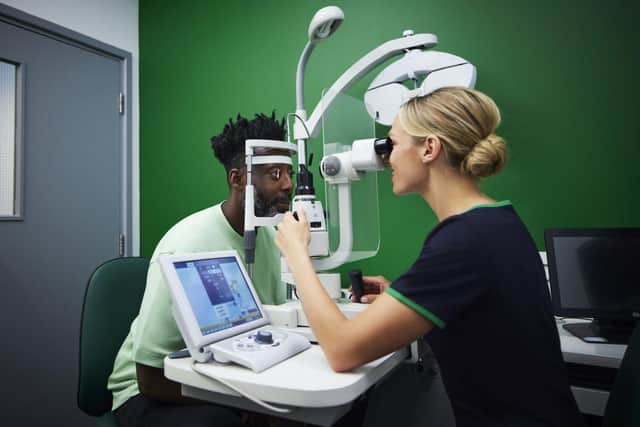

Jude Edwards, optometrist director at all three locally owned and run Specsavers stores across Northampton, says: ‘Prevention, early diagnosis and treatment of common eye conditions are key to reducing the number of people suffering sight loss unnecessarily; a large percentage of sight loss could be avoided if people have their eyes checked regularly.
‘Despite sight being the sense that most people are concerned about losing, many people don't actually have their eyes checked every two years. Sight tests are essential for everyone even if you think your eyes are fine, because damage can be done before you notice it. For example, an eye test can spot glaucoma years before people notice a change in their vision, and it can be treated if found soon enough.’
Fellow director Mukesh Patel continues: ‘As well as assessing your eye health, a sight test can detect other health conditions such as diabetes, high blood pressure, raised cholesterol, risk of stroke and heart disease. So, alongside not smoking, eating a healthy diet and staying active, I would urge everyone to have an eye test every two years.’
Eye health can also be affected by the overuse of electronic screens. Screen fatigue won’t permanently damage a person’s eyes, but it can make symptoms of existing eye conditions, such as short-sightedness, more pronounced.
‘These days, we engage daily with computer monitors, mobile devices and TV screens and individuals can suffer from screen fatigue,’ concludes Mukesh. ‘Overuse of screens without a break can result in dry eyes, tired eyes and even blurred vision. We should all give our eyes a rest by following the 20-20-20 rule – looking away from the screen for 20 seconds every 20 minutes and focusing on something 20 feet away.
‘It’s also advisable to break up screen time by spending time outdoors, which enables us to focus on things further away. Following the 20-20-20 rule and having your eyes tested every two years will significantly reduce the occurrence of sight loss in our communities.’
For further advice or to book an eye test, visit the Specsavers Northampton store at 50-52 Abington Street, Northampton, Northamptonshire, NN1 2AP or call 01604 604996. Alternatively, you can visit one of the sister sites at Specsavers Weston Favell