
‘This beautiful village will be ruined’ – residents hit back at plans for 70-acre solar farm near Rushden
Plans for a solar farm on land on the west side of the village of Wymington have attracted dozens of objections from local residents, who believe the proposal to be ‘unsuitable’, ‘an eyesore’ and would ‘blight the local landscape’.
Documents were submitted by the applicant, ABEI Energy Ltd, and received by Bedford Borough Council on July 25, with the proposal just 2.2 miles from Rushden town centre currently awaiting decision.
Of the 54 comments on the planning application, 53 are objections.
Some criticised the ‘temporary’ nature of the solar farm, as plans indicate it will be in place for ‘a period of approximately 40 years’, and others lament the loss of green space and the impact it coudl have on local wildlife.

One commenter said: “This is a small quiet village, the footpaths are used by many dog walkers, exercising, and just people in general wanting a nice walk. You will never walk these footpaths and not see at least three or four people, any time of the day, enjoying the beautiful countryside. “I myself use these everyday with my granddaughter, whatever the weather. It helps clear my head, recharge my batteries and find peace and quiet from struggles of everyday life. “We frequently see foxes, deer, barn owls and also badgers, which is a privilege, and something that you could never tire of. “What happens when they are moved on, and are surrounded by plastic solar panels?
“This planet is not ours, we only borrow it for the time we are here. We should respect and look after our open spaces.
“I was born in this village 60 years ago and this saddens me. This beautiful village will be ruined.”
Another added: “The proposed applications will severely impact on me, my family and friends' daily enjoyment of walking the footpaths and the surrounding countryside, this proposal will effectively turn it into an industrial estate walk.
"I am not in the best of health and walking in this countryside as I have for over 65 years is a definite mood and health booster.
"This application will destroy habitats and displace wildlife to in-between the fences on the rights of way, where the larger will not be able to escape human and canine interaction, scared animals will end up displaced on the surrounding roads causing accidents. There is an amazing array of wildlife living in the area of the application, a huge badger population along with hares, bats and owls, the list is endless.
“Planting a few trees and bushes will not mask the industrialisation of our lovely countryside.”
A third said: “We would like to convey our absolute objection to the planned solar farm.
“We have only lived here for 18 months and have enjoyed the beautiful walks with our dog the countryside will be absolutely ruined if the planning for the solar farm goes ahead.
”We certainly would not have moved here if we had known this could've happened.”
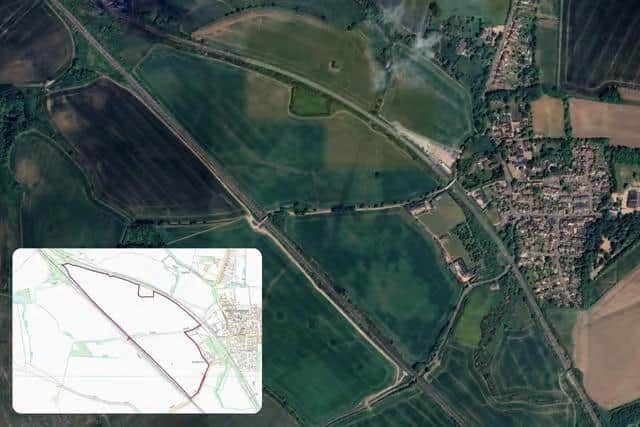
The plans include a solar farm development approximately 26.4 megawatts, as well as relevant infrastructure on land known as Bottom Railway near Podington Road, Wymington.
The total space the solar farm would occupy is approximately 75 acres (30.5 hectares) and is currently made up of two low-lying agricultural fields divided by a public right of way and bounded by an access track or tree lined hedgerow. The applicant says the solar farm would remove approximately 27.5 hectares of land from predominantly arable use (68 acres), though the land ‘will stay in general agricultural production, through sheep grazing.’
The southwest edge runs parallel to a railway line, regularly used by East Midlands Railway (EMR) on its route from London to Wellingborough.
Should the plans go ahead, construction would be expected to take place for approximately 10 months.
The planning documents read: “The proposed development has been designed to provide a source of renewable electricity to support a transition to a low carbon economy. Throughout the operational phase, the land beneath and between the solar arrays can be used for agriculture, eg sheep grazing.
“The proposed development is easily reversible, with minimal disturbance during the construction phase. Therefore, the land would be capable of being restored as close to its original condition, or better, at the end of the operational period.”
Another objector Simon Marsh from nearby Podington highlighted several key issues on the application relating to the project including the loss of agricultural land and food security, landscape, amenity and visual impacts, and biodiversity and habitat disruption.
He said: “The evidence over the past five years shows that there are significant potential negative impacts – particularly where solar farms are built on high quality agricultural land, in sensitive landscapes or with poor consideration of biodiversity and community effects.”
The full application can be found online here or by searching with the reference 25/01472/EIA on the Bedford Borough Council website.