
Spitfire fly-past and a Blue Plaque for Higham Ferrers war hero
A town ‘full of heritage, history and heroes’ turned out in force to honour their own decorated wartime night-time fighter pilot.
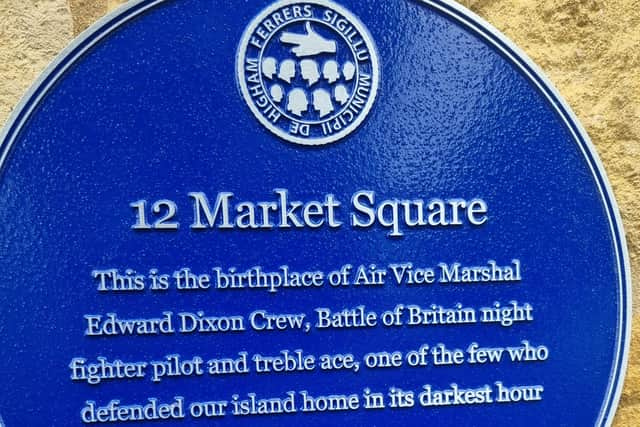
With flags flying, a new Blue Plaque has been unveiled at 12, Market Square in the heart of Higham Ferrers where triple ace pilot Air Vice Marshal Edward Dixon Crew was born.
Months of planning went into the Higham Ferrers Town Council-hosted event, which also commemorated the 85th anniversary of the Battle of Britain.
After his aviation training, Crew had been posted to No 604 Squadron in July 1940 at the height of the Battle of Britain.


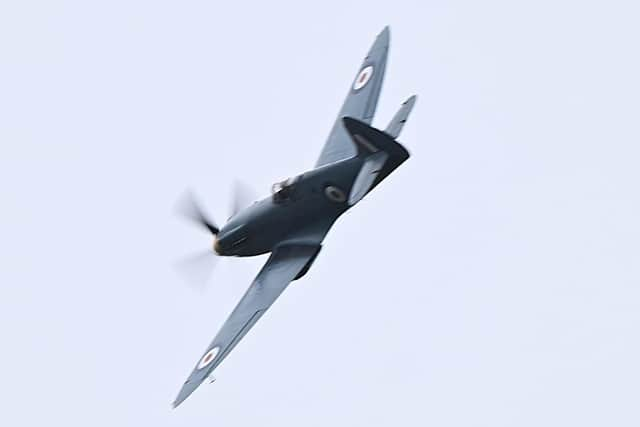
One of the highlights of the day was a fly-past by a Spitfire of the RAF Battle of Britain Memorial Flight from RAF Coningsby in Lincolnshire and the pilot, Squadron Leader Mark Sugden MBE, surprised and delighted the cheering crowd below by undertaking three fly-pasts.
Air Vice Marshal Crew had been posted on secondment to the Royal Canadian Air Force after the war and one of the VIP guests at the unveiling included Colonel David Holmes from the Canadian High Commission.
Air Force cadets paraded and members of the local Trucks, Troops and Stores re-enactment group, complete with a row of gleaming vintage vehicles – a 1945 US Army truck, the workhorse of the US Army during WW11, a 1939 Standard Flying Eight vehicle and a 1947 Ford V8 Pilot car - helped set the mood.
Over at the Bede House, which was decorated in Union flags by new councillors Louise Parker and Penny van Spall, The Candy Bars group were gearing up to entertain guests with wartime songs after the unveiling.
An inspirational pilot
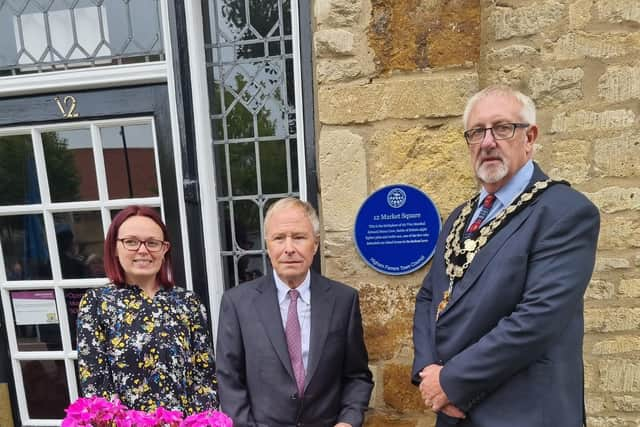
Standing in front of the Blue Plaque with Crew’s son, Nigel, who was visiting from his home in Kent, mayor Gary Salmon, said that Higham Ferrers was ‘full of heritage, history and heroes’ and that Air Vice Marshal Dixon Crew had been an ‘outstanding and inspirational’ RAF officer.
He said it was appropriate that on the 85th anniversary of the Battle of Britain that Higham Ferrers recognised its own very successful night-time fighter pilot who was certainly a hero.
Crew’s many wartime actions involved downing 15 enemy aircraft – making him a triple ace – and undoubtedly saving thousands of lives.
Later, as the commanding officer of No 96 Squadron, he personally accounted for 31 German V-1 pilotless flying bombs (Doodlebugs).
Crew’s son said that having a Blue Plaque commemorating his father was a wonderful honour, but it was terribly sad that you had to be dead to get it.
He said: “My father would have been deeply, deeply touched.
"No 12 Market Square was not just some passing house, it had been in his family for 66 years.”

Gwen Tobin of Higham Ferrers Tourism Committee told how back in 2021, committee members decided they wanted to know more about the people and places featured in the town’s Blue Plaques.
A year of research followed which resulted in a leaflet and a Blue Plaque website (www.blueplaquetrail.com) setting out the Blue Plaque trail, which takes about an hour to complete.
The project had helped increase the number of visitors to the town, so much so that the first 500 leaflets had all gone.
Now, a new leaflet had been produced, including the new Blue Plaque honouring Air Vice Marshal Edward Dixon Crew.
After the unveiling, the focus shifted to Bede House, where a row of information boards told of the life of the Air Vice Marshal and showed various wartime planes that were operational during the war.
Tea and wartime-era refreshments were also on offer, including Spitfire-shaped biscuits.
Determined and distinguished
Crew’s impressive career continued after the war and earned him the Commander of the Order of the Bath to add to the Distinguished Service Order (DSO) and Bar and the Distinguished Flying Cross (DFC) and Bar.
He received the DFC in July 1941 for his outstanding ability and determination in engaging the enemy – and the following year, he was awarded a Bar to his DFC after another eight night-time victories.
His tactics and leadership while the CO of No 96 Squadron earned him a DSO and after the war when he commanded No 45 Squadron during the Malayan Emergency, he received a Bar to his DSO.
He held several other key positions, including secondment to the Royal Canadian Air Force, command of RAF Bruggen in Germany and leadership of Air Forces Borneo during the Indonesia Malaysia confrontation.
He also served at the Ministry of Defence as Director of Operations (air defence and overseas) and was appointed a Commander of the Order of Bath on his retirement in 1973 for his distinguished service.