
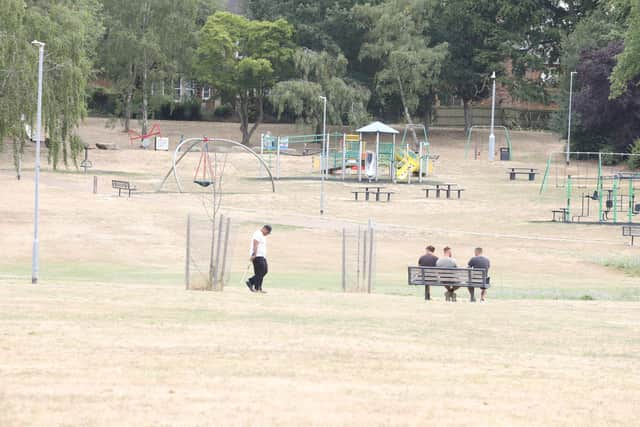
Prolonged dry spell in Northamptonshire as virtually no rain falls in July
As the prolonged dry spell continues in Northamptonshire, official figures have shown that virtually no measurable rain fell in July.
Across the county no more than 1mm of total rainfall was recorded for the entire month of July according to the Met Office.
This historic low placed the county among 19 across England that saw virtually no measurable precipitation, contributing to a prolonged dry weather and drought status over a large area of the country.
Half of England has been declared in drought by the Environment Agency – a large swathe of central, eastern, and southern England is now experiencing a ‘flash drought’ – which develops very quickly brought about by a combination of very low rainfall and higher temperatures.

Helen Wakeham, director of water at the Environment Agency and chair of the National Drought Group, said: “The hot and dry weather means we are currently using water faster than nature can replenish it.
“A second consecutive summer drought is an exceptionally serious situation and one that will have long-lasting impacts on our environment, wildlife, and the economy.
“We want everyone to stay safe and hydrated during the hot weather but every drop we can save is a drop more for nature and agriculture.”
Rivers are running low, farmers are having to harvest crops early, wildfire risk is increasing, and millions of people are living under restrictions on water use.
The current drought now means there have been three in the past five years – 2022, 2025 and now 2026.
However, the summer has continued to be exceptionally hot and dry. July has seen just 7 per cent of expected rainfall, falling to 1 per cent across southern England.
Combined with three heatwaves, including 12 consecutive days of temperatures above 30C, water storage has begun to deplete. The higher temperatures also mean water is evaporating from soils and vegetation, making wildfires more likely.
Met Office Chief Meteorologist Will Lang said: “The warm and exceptionally dry conditions experienced across much of England over recent months are continuing to have a significant impact. Many areas have received very little or no rainfall throughout July, extending a period of below-average rainfall that has persisted across parts of the country since spring.
“While there are indications of occasional unsettled spells during the first part of August, bringing the chance of rain to some locations, there is currently little sign of the widespread, sustained rainfall that would be needed to make a significant difference to the areas most affected by the dry weather.”
The seven areas in drought are East Anglia, Hertfordshire and the whole of London, Thames Valley, Hampshire & the Isle of Wight.
Devon & Cornwall, The West Midlands and Wessex (covering Dorset, Somerset, Wiltshire, and south Gloucestershire).
Alongside seven areas in drought, Northamptonshire falls into an area in ‘prolonged dry weather’ with Kent & East Sussex, Cumbria & Lancashire, Greater Manchester, Merseyside & Cheshire, East Midlands, Lincolnshire, The rest of Solent & the South Downs.
Anglian Water introduced a hosepipe ban for customers on July 11.
People are being reminded to help save water with ‘small steps’, such as turning off the taps when brushing teeth or shaving, taking a shorter shower or fixing leaks.