
North Northamptonshire Council executive approves plans to cut ward member empowerment fund and produce youth empowerment grant scheme with half the money
North Northamptonshire Council’s (NNC) executive has unanimously agreed to ditch a pot of grant funding allocated by ward councillors, as it has pledged to move half of the cash to a new funding scheme for the youth council.
Since 2022, the authority has provided £2,000 for each of its councillors every financial year in a ‘ward member empowerment fund’, which is used to hand out small grants to community groups and projects that will benefit their area.
The plans to slash the current councillor-focused fund and develop a new youth empowerment grant scheme have been an ongoing debate over the past month and a source of controversy.
It was deferred for further scrutiny back at a previous executive meeting in April due to concerns raised by opposition councillors around how the loss of funding would impact local groups.

The original proposals were to repurpose £68,000 of funding (from the £136,000 total budget) to the new grant scheme aimed at young people.
The remainder of the money was expected to be spent by ward members over a three-month application period, with any leftover returned to the budget.
Despite a recommendation from scrutiny to retain the partial allocation and allow members to submit funding applications for a full 12-months, the executive voted to go ahead with scrapping the members’ fund altogether.
Leader of the Green group on NNC, Cllr Emily Fedorowycz, who had previously called out the executive for the plans, asked why the recommendations from scrutiny had been ‘completely ignored’.

She said: “Funding our youth is long overdue following decades of cuts to youth provision. Slicing up a tiny pot of community funding rather than funding things properly is both unfair to our young people and our community groups, who are already stretched.
“Now the community funding is proposed to be cut altogether, absorbed back into the council coffers as a so-called ‘saving’.
"This is not a saving. The Institute of Volunteering Research shows that for every £1 invested in the voluntary sector, it generates over £5 of value.
“This is a deep and far-reaching decision that will break trust in this authority and hit people hard.”
Cllr David Brackenbury (Conservative) also spoke in objection to the proposals, calling them ‘mean spirited’.
He said: “The beauty of the member’s empowerment fund is that it enables good ward councillors to assist projects that benefit residents across all age ranges.
“It is worth pointing out that the sums in this paper are small, but the effect on local communities is far-reaching. The cross-party opposition to these proposals should speak for itself.”
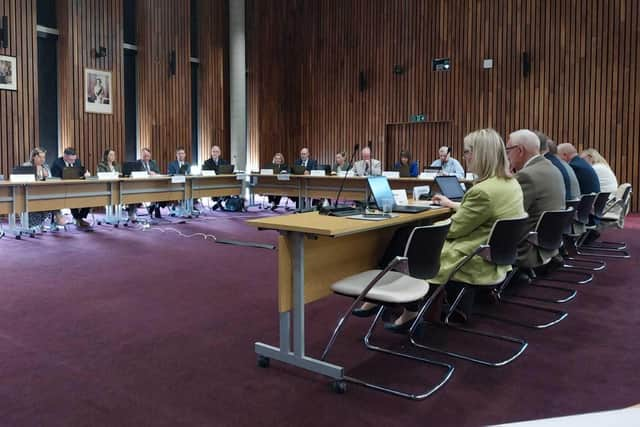
In total, 13 people spoke on the item in the Corby Cube council chamber, representing current and former elected members, members of the public and a range of political colours. Just one councillor spoke in support of the recommendations.
Labour councillor David Baker said he was previously in support of the first iteration of the scheme, which suggested keeping half of the members’ funding, but not the current version with the total cut.
He suggested that the Youth Advisory Council in the new scheme should be encouraged to engage with the ward councillors in their areas, or ensure that the scheme gives councillors some ability to submit applications themselves or discuss them with the youth council.
Cllr Simon Fairhall (Lib Dem) told the meeting that the amount of funds that had not been distributed over the last five years was ‘shocking’ and ‘an indictment on our performance as councillors’.
According to data presented in the council report, last year around £86,000 was spent out of the total £136,000 funding pot. Since 2023/23, ward councillors spent just over 50 per cent of the cash available through the fund, leaving nearly £280,000 untouched.
Reform UK backbencher Cllr Julie Lumsden also opposed the changes, listing a number of projects she had worked cross-party to support in her area and asking the executive panel to reconsider.
She said: “I’m well aware we do have to look at costs and the public purse has to be scrutinised fully.
“I do feel the way this is going, vital funding will be taken away from certain areas. I’m also fully aware that young people should have a voice and they should have some funding.
“I believe it should be brought together, ward councillors and the youth council working together – whether that be half and half of the funding, or youth council using what hasn’t been utilised by the ward councillors.”
Syl Rielly, a Corby resident, also agreed that the funding for young people should not come at the expense of the ward member fund, raising the importance of the local connection through elected members to identify and provide funding for grassroots projects.
She told the chamber: “Councillors who represent wards know their communities better than anyone else. They know where support is needed most.
“A centrally managed fund or large-scale programme cannot always see those smaller local issues in the same way.
“As a resident, I think we need to think carefully about what happens if funding like this disappears. A local project quietly closes, a volunteer group scales back because costs become too high, a youth activity disappears.
“Over time, communities become less connected, less resilient, and more isolated.”
NNC’s head of legal services, Kamila Coulson-Patel, said the two grant funding schemes could not be run concurrently as it would require an additional resources budget in the region of £20,000.
The council’s executive member for finance, Cllr Graham Cheatley, also backed the report and said it would create opportunities for young people, but that it was ‘entirely understandable that there will be some disappointment’ that the funding would end.
He said: “The reality is that this funding has not been used consistently across all wards. It isn’t about removing support, it’s about refocusing it where it can make the biggest difference.”
His fellow executive member, Cllr Kirk Harrison, who holds the portfolio for regulatory services, pointed out that the fund was discretionary and needed to be reviewed at a time of real financial pressure.
Addressing concerns about the impact on local organisations, he also highlighted the amount of funding that had ‘failed to reach communities’ and was ultimately returned to the general fund.
He said: “Rather than a cut, this is in reality a reallocation of those funds.
“Our responsibility as an executive is not simply to continue things because they’re popular or well-intentioned, it’s to ensure that our decisions are right and proper and sustainable.”
The changes to the budgets were unanimously approved by the executive committee.