
Meet the Raunds woman who fought for justice after being given infected blood
A Raunds woman fighting for justice alongside thousands of other people given infected blood by the NHS has welcomed the national Infected Blood Inquiry report.
Sue Wathen was a fit and healthy young teacher in her 20s when she became one of the 30,000 people infected through blood transfusions that carried life-threatening viruses – Hepatitis B and C, HIV and CJD.
It wasn’t until years later she discovered she had been living with Hepatitis C (Hep C), that can infect the liver and if left untreated can cause serious and potentially life-threatening damage.
Over three decades, Sue had suffered from recurring ‘weird and wonderful’ illnesses that even surprised doctors. She had CT scans and numerous blood tests.
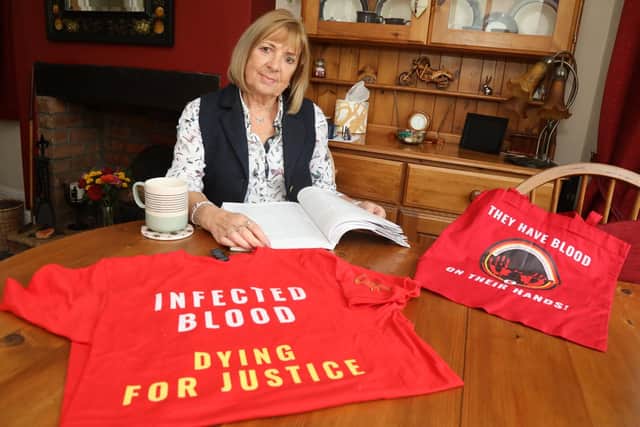

But it wasn’t until in 2014, when a new consultant did a blood screening for Hep C, that her viral load results came back at 2,600,000 – it should have been zero.
Sue says she is one of the ‘fortunate’ survivors of the blood scandal.
She said: “It is a calamity, it is a disaster. There are people who are far more ill than me. People who have cirrhosis and liver cancer. People have since passed away.
"I feel like I have survived a disaster. It’s the impact that it’s had on so many people’s lives. I feel fortunate in comparison to other people. My story pales into insignificance.”
For more than 30 years, Sue had carried on with bouts of ill health that took its toll on her first marriage, her two sons and her career.
She lived with ill health not knowing the cause. At one point in her illness she would cough so hard she would vomit, sometimes changing at school before work – she learnt to take a sick bowl with her. On other occasions her hands blistered so badly she had to wear huge plasters to hide the backs of her hands from school pupils. Another time she put her yellowed eyes down to a love of carrots – but it was jaundice.
She now looks back and can see the unusual symptoms were signs of her underlying illness but says she was ‘gaslit’ by some medics into thinking she was making it all up.
Even when her Hep C blood test came back positive, prompting Sue to ask for a second test, one doctor still didn’t think it possible she had the disease.
She said: “He sat at his desk and put his head back, looked at the ceiling and said ‘you won’t have that’. I said, ‘nevertheless I would like another test’.
"When it came back positive all I got was a two-line letter – ‘an appointment will be sent to you in due course’, not ‘we are sorry to say’ or ‘come in straight away’. No leaflet. No information. I had no idea what Hep C was.”
In the decade since her diagnosis, Sue has had to battle for answers. She very nearly missed out on one compensation scheme because all her medical notes pertaining to blood transfusions had been destroyed.
Only the diligence of one consultant, going through a pile of medical records, revealed vital evidence, confirming Sue had received multiple blood transfusions. Luckily, a flimsy piece of copy paper had stuck to the back of A4 within the bundle and confirmed the transfusions.
Sue admits only briefly feeling sorry for herself once but wanted to remain strong.
She said: "I remember I was sitting on the floor at home crying. I said to myself ‘if you die tomorrow, you’ll have twice the life of some people, so get up and fight’.
“I have never been one to dwell on things. The reason I did all this fighting is because I felt I was one of the strong ones. I could be the voice for those who wouldn’t or couldn’t.
"I told everybody and anybody.”
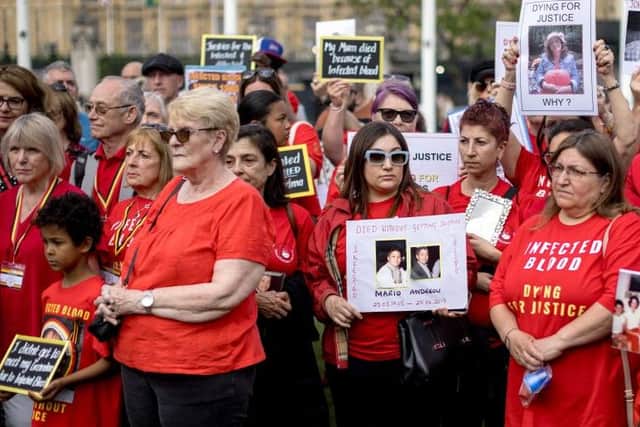
Joining with her ‘blood friends’, Sue travelled down to London to hear the findings of the Infected Blood Inquiry under the chairmanship of Sir Brian Langstaff as he published his damning 2,527-page report.
Sue said: “Sir Brian has done a magnificent job. Even the Prime Minister didn’t mince his words. He said the scandal was ‘shameful’.
"You put your trust in the whole system. Over the years, successive governments have done a wonderful jobs of hiding this. As Sir Brian said ‘it was a paralysis of decision making’ by the system – the civil servants, then the politicians, then the doctors who failed to carry out proper checks.”
A final compensation scheme is being set up by the government with payments expected later this year. The total cost is expected to run into billions of pounds and Sue feels the question of costs need addressing.
Sue said: “It’s always been about money. But it was about money – saving money. It was using cheap products (blood) from US and British prisons. It was about using up stocks of (infected) blood. It was all about the cost. Now the cost is going to be far greater – it’s not the cost to the government but in human beings.”
Now back at the home she shares with husband Peter, the couple are looking forward to getting back to normal and are planning a holiday. He has only just come out of hospital and is recovering from sepsis that saw him in ICU for 20 days.
Friends Sue has made through the blood scandal keep in touch in their Whatsapp support group and will carry on meeting up for social events.
She added: “I hope the inquiry is the closing of the book, not the start of a new chapter.”
To read the full report go to https://www.infectedbloodinquiry.org.uk/.