
Kettering paramedic working in Gaza describes 'conveyor belt of carnage' helping at UK Government emergency field hospital
A Kettering paramedic has described the situation in Gaza as a 'conveyor belt of carnage' – putting two killed children in body bags – during a three-week stint at a UK Government emergency field hospital.
Sam Sears has given a disturbing first-hand account of life in war-torn Gaza after being deployed with frontline medical charity UK-Med, as part of the UK Government’s humanitarian response to the crisis.
More than 500,000 patients have now been treated at two Foreign, Commonwealth & Development Office (FCDO) funded emergency field hospitals based in Al Mawasi and Deir El Balah.
Sam, 44, from Sudborough, experienced a ‘baptism of fire’ on his arrival in Gaza – dealing with a mass casualty incident which saw two young children die from horrific blast injuries.
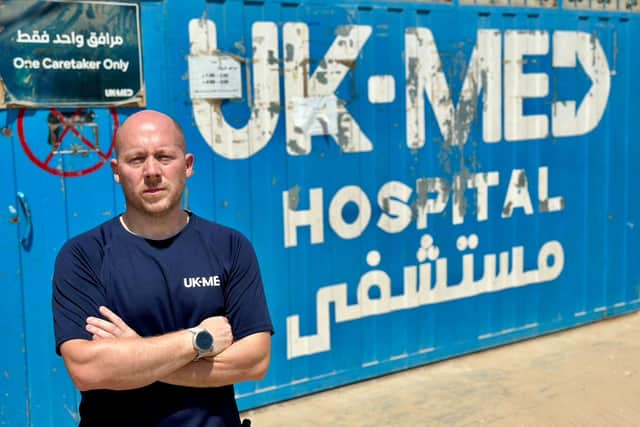

He said: “Gaza was just relentless. We were dealing with a conveyor belt of carnage with regular mass casualty incidents and a steady stream of blast and shrapnel injuries, and gunshot wounds.
“One of the first incidents I dealt with will live with me forever. When I went into resus, there were three beds – one with a young male fighting for life, and two children aged nine and 11 who were deceased.
“I was tasked with moving the two deceased children out the way to make space for other casualties coming in. I put the children in body bags and zipped them up.
“In the UK I’ve had to deal with a number of deceased children, but the difference was I’m never involved with putting them in a body bag. It’s normally a very calm, slow situation, allowing parents time to grieve.
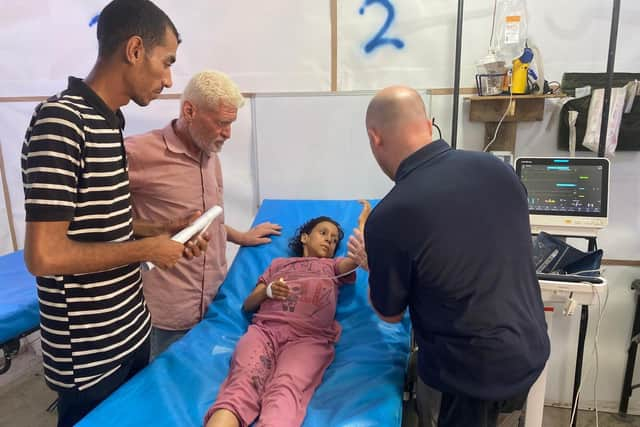
“So it was particularly heartbreaking putting a child in a body bag, seeing their face for the last time, then moving them out the way so we could treat more people.
“Part of me felt guilty that there was no dignity for them because the emergency situation meant it was a case of ‘They are dead, let’s get them out the way to free the beds’.
“But there was simply no alternative because with such a high volume of casualties, we had to focus on people we might be able to save.”
More than 59,000 have been killed in Gaza and more than 90 per cent of the population have been displaced, many repeatedly.
Prime Minister Kier Starmer has announced that the UK will recognize a Palestinian state at the UN General Assembly in September unless Israel agrees to a ceasefire in Gaza, stops building settlements in the West Bank, and commits to a two-state solution.
On Saturday, the UK announced another £8.5m for UN aid to Gaza to deliver urgent food, water and fuel assistance to areas in the most acute need.
The money, to be delivered through the UN’s Office for the Co-ordination of Humanitarian Affairs (OCHA), is part of a £101m UK commitment to the Occupied Palestinian Territories this year.
In the last financial year, Manchester-based UK-Med received £11.5m of support to run two emergency field hospitals in Gaza. A further £7.5m of support for the UK-Med-run field hospitals was announced last month.
UK aid pays for medical volunteers such as Sam’s regular roles to be backfilled to ensure the NHS is not impacted.
Sam – a paramedic with East Midlands Ambulance Service, based in Kettering - returned to the UK on July 31.
He said: “The worst moment was putting the two kids in body bags – but there were so many heartbreaking moments.
“In another mass casualty incident, I remember about four people came in one after another… dead. There was nothing we could do.
“We had a child aged about eight come in with his neighbour’s auntie because his whole family had been killed in an explosion and he was the only one left. He had minor injuries luckily, but had lost his whole family. He just looked lifeless behind the eyes – just numb.
“Another case that sticks in the mind was a 16-year-old boy who had suffered blast and shrapnel wounds. One had gone into his spine in his back and left him paralysed alongside needing to have his left arm amputated.
“His 18-year-old brother also needed treatment and was unaware of this boy’s plight. When we told him he just broke down crying. His brother was the only family member left so there was a realisation he’d need to look after him for the rest of his life.
“We were getting an increasing number of severe food deprivation cases, specifically pregnant ladies or newborn babies because the mothers couldn’t breastfeed because they simply had no nutrients to pass on.”
But Sam said: “It might sound weird, but I am keen to return to Gaza. What keeps you going is that you really are making a difference and saving lives.
“That first night, another child came in with shrapnel embedded in their stomach and bleeding internally. I was personally convinced they would die, but we got him to surgery within 20 minutes.
“Next day when I saw them they were recovering well and the prognosis was really good. Gaza’s the hardest thing I’ve ever done but moments like that that keep you going. We have saved that child’s life.
“Working there has undoubtedly made me a better paramedic, so I bring the experience and skills gained back to my NHS day job.
“You hope you never come across mass casualty incidents in the UK, but I’d be much better prepared to deal with something like the Manchester Arena terror attack now.”
Sam admits the constant sound of bomb blasts and fighting became like ‘background noise’.
He explained: “I’d previously done humanitarian work in Sierra Leone, Rwanda, Ukraine and Turkey following the earthquake, but Gaza is like Ukraine or Turkey times one thousand.
“There was the constant hum of drones flying around all the time. You’d see and hear helicopter gunship hovering above and firing missiles and fighter jets launching attacks. There was constant gunfire.
“I think the closest explosion was about a kilometre away, but was still deafening and close enough to give you a shake. Worryingly, you get used to it and it becomes background noise.”
Brave Sam’s fellow paramedic partner Anna and his family were relieved when he returned home safe.
He admitted: “It’s only natural my loved ones would be worried when you see the horrors of Gaza on the news every night.
“I think my mum was worrier-in-chief and everyone was so happy when I texted them to let them know I’d crossed the border to head home. My step-dad texted me to say my mum was crying.
“If I was on the phone reassuring my partner everything was okay, you’d hear an explosion or gunshots, and she’d say ‘Oh, is that…?’ and I’d say ‘It’s okay. Honestly, it’s far away’. I’m not sure how reassuring it is saying ‘It’s fine here’ and next thing you hear big bangs in the background.
“Gaza has definitely put things into perspective for me. I think I’ll have a much more ‘live life for the moment approach’ to life now.”
Minister for International Development Jenny Chapman said: “The humanitarian catastrophe in Gaza continues and we urge Israel to reverse its decision to expand military operations. All sides must return to the ceasefire to end the appalling suffering and secure the release of all hostages.
“It is unacceptable that so much aid is waiting at the border - the UK is ready to provide more through our partners, and we demand that the Government of Israel allows more aid in safely and securely. The insufficient amount of supplies getting through is causing appalling and chaotic scenes as desperate civilians try to access tiny amounts of aid.
“The UK is supporting the UN and other humanitarian partners who are delivering desperately needed support in the most difficult circumstances. Our announcement today will help to address that urgent need, but only if Israel allows Gaza to be flooded with aid.”
In 2024, Sam travelled to Rwanda to support the humanitarian effort and aid the country after the Marburg Virus Disease outbreak.