
Five shots fired at Corby's Hazel Wood before 'gun jammed' as alleged drug dealer 'tried to shoot teen in the head', jury hears

An alleged drug dealer tried to shoot a boy twice in the head before stabbing him, the opening of an attempted murder trial has heard.
Matas Sukaitis is said to have been the man who shot a teen in the back in Hazel Woods, before allegedly stabbing him repeatedly, a jury was told yesterday (Wednesday, June 3).
The victim, Lennon Tierney, was left in a ‘poor state’ on the floor while Sukaitis is said to have fled to a ‘hideout’ at his co-defendant’s home on the Beanfield estate.
Prosecutors say that Sukaitis was running the ‘Frankie’ drug line when he attacked the boy, then aged 17 but now 18, in the woods on April 11 last year.
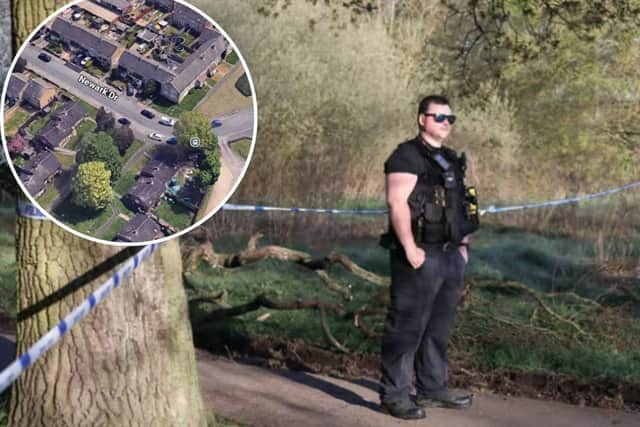

Tierney was left with a shattered vertebrae and a perforated bowel. He told police that the shooter had tried twice to shoot him in the head, with the gun jamming on both occasions.
After hiding from authorities at the house on the Beanfield estate, Sukaitis is said to have got a taxi in the middle of the night to a house in Kettering where he told the occupants he needed to ‘chill’.
The court was told that Sukaitis changed his drug dealing phone seven times in the four months around the shooting. He also allegedly sent out a bulk text marketing heroin and crack cocaine to 217 Corby users on the morning of the shooting.
The crown’s case is that Sukaitis, 21, was aided by Ben Smith, Robert Quittenton and Sam Stimpson, who are said to have helped him cover up his involvement in the attempted murder in the days before and afterwards.
All four men are standing trial at Northampton Crown Court. Sukaitis, of Chaucer Close, Corby, denies attempted murder, possession of a firearm with intent to endanger life and possession of a knife in a public place.
Smith, formerly of Newark Drive and now of Halford Street, Thrapston, Quittenton, 76, and Stimpson, 38, both of Brambleside Court, Kettering, deny assisting an offender with the intent of impeding his apprehension.
The shooting
Between 4.20pm and 4.30pm on April 11, a witness was walking through Hazel Wood with his daughter when he heard gun shots.
“It’s a weekday, it’s the middle of the day, it’s daylight and it’s a public park, and this man and his daughter are walking their dog and hear gun shots,” said prosecutor John Lloyd-Jones.
Door-cam footage showed to the jury from a home in nearby Llewellyn Walk clearly recorded four gun shots, then a pause, then a fifth shot at the time of the incident.
The man went towards where he had heard the shooting and came across Lennon Tierney, lying on the ground with an older man standing over him. This older man was John Campbell.
"He (Mr Campbell) was shouting into his phone something about getting an ambulance,” said Mr Lloyd-Jones.
Multiple ambulances, the air ambulance and police officers rushed to the wood.
They found Mr Tierney on the ground in a ‘pretty poor’ state.
"He was unable or unwilling to fully articulate what happened to him, beyond what he’d told the witness, that he’d been shot and stabbed,” said the barrister.
What did Mr Tierney say had happened?
After the shooting, Mr Tierney was visited in his hospital bed by police officers who asked him what had happened. He told them that he had been sitting on a bench in Hazel Wood with a friend and someone had ‘appeared’ and ‘started shooting’.
Mr Lloyd-Jones said: “He was struck in the back, he got down, the person put a gun to his head, the gun jammed, he tried again, it jammed again. The man had then stabbed him and kicked him in the face, damaging his tooth.”
Mr Tierney said that he couldn’t remember what he was wearing or what he looked like, and told the officers he didn’t want to make a complaint because he was ‘scared’. He said he had no idea why he had been targeted.
But after the police officer turned off his body-worn camera, he asked him whether he would write down the name of the person he thought had shot him.
He whispered into his mum’s ear and she wrote down the initials ‘MT’ on the paper, then he whispered again, and she wrote the name ‘Frankie’.
In a later interview, carried out last June, he confirmed the man he believed had shot him was Matas Sukaitis, a man he’d known for about seven years.
Mr Lloyd-Jones said: “He said he’d last seen him a couple of days before when he’d ‘spudded’ him. That’s slang for fist fighting.”
What were Mr Tierney’s injuries?
Mr Tierney was taken to Walsgrave hospital in Coventry, the region’s major trauma centre.
A CT scan showed the bullet had gone through his spine at the base of his back. It had hit his L5 vertebrae with such force that it had been shattered outward, the jury was told. Sharp bone fragments had been pushed into his spinal canal. The bullet had come to rest in subcutaneous tissue close to his belly button.
It had gone through his back and almost out the other side.
Pockets of gas were identified by the scan, indicating Mr Tierney’s bowel had been perforated. He had to undergo surgery to remove part of his bowel.
Stab wounds in his thighs and shins were treated with steri-strips.
The gun
Bullet casings found in the woods contained no fingerprints, DNA or markings related to a previously-used weapon. But a firearms expert said they indicated that the weapon was a ‘reactivated’ – a gun that had been deactivated but then modified to fire live rounds.
Mr Tierney told police officers he thought it was a Glock 17 pistol.
"The question for you,” Mr Lloyd-Jones asked the jury, “is who was it that fired that weapon in Hazel Wood that nearly killed Lennon Tierney?”
What happened in the build-up to the shooting?
The court heard yesterday that Sukaitis had allegedly been sending bulk marketing messages for his Frankie line from the home of Ben Smith in Newark Drive, which is close to Hazel Wood.
The day before the shooting, from his home in Kettering, Quittenton had hired a Toyota from Europcar.
Mr Lloyd-Jones KC said on April 10, the car entered a pattern of making a call to the Frankie line, driving to Corby, making another call to the line, then driving back to Kettering.
Mr Lloyd-Jones also alleged that Sam Stimpson was Quittenton’s passenger on those journeys.
At 8am on the morning of the shooting, April 11, Sukaitis sent a message to his 217 customers saying ‘Good morning’. Mr Lloyd-Jones said the message was later found on the phone of a drug user, Matthew Causer. He had saved that number under the name ‘bump,’ which is a colloquial term for a small amount of drugs.
The prosecution says call data places Sukaitis at Smith’s home that morning, and into the afternoon.
At just before 4pm, Quittenton called the Frankie line, and was then again in motion in his car towards Corby.
A still from council CCTV in Sower Leys Road showed Quittenton’s Toyota heading northwards toward Hazel Wood at 4.09pm.
At that time, a call was made from the Frankie line to Quittenton’s mobile, and at 4.22pm the Frankie line made its last call to an unknown number before, Mr Lloyd-Jones says, it ‘dropped’.
From that point, calls were made to the line, but were not able to get through.
Mr Lloyd-Jones said to the jury: “You may wonder why it dropped off the network never to reappear, six minutes before the shooting in Hazel Wood.”
At 4.22pm, Quittenton’s car was seen travelling back to Kettering.
Matas Sukaitis
Sukaitis, 21, was running the ‘Frankie’ drugs phone line between January 20 and May 16, 2025, the prosecution says.
He was known in Corby by the name Frankie, or MT. The line sold crack cocaine and heroin. In court, he wore a blue Under Armour jumper and had his hair cropped short. An older man and a woman were in the public gallery to support him.
Benjamin David Smith
At the time of the shooting, Smith lived at Newark Drive, described by counsel as an ‘important’ address because of its proximity to Hazel Wood and its alleged use by Sukaitis before and after the shooting.
Smith lived there with his partner Sally O’Brien and it is to this address that Sukaitis allegedly fled after the shooting and stayed for a few days. In court, Smith wore a white shirt with sunglasses hooked over a button and had to sit separately from the defendants with one leg raised following an injury.
Robert Quittenton
The oldest of the defendants, at 76, Quittenton lives at Brambleside Court in Kettering. He walks with a stick and hired a car the day before the shooting, which made several trips to and from Corby in the days surrounding the attempted murder. He had also made many calls to mobiles associated with Sukaitis.
Sam Stimpson
Stimpson was Quittenton’s lodger at Brambleside Court at the time of the incident. He also made and received calls to Sukaitis’s phones and was allegedly in the car when the lead defendant was taken on various trips in Kettering following the attempted murder. He wore a blue shirt in court, and had his long beard tied up with hairbands.
What will the jury hear?
Fourteen jury members have been chosen, but two will be excused after the opening of the case. This accounts for anyone on the jury who may have to drop out if they suddenly recognise someone involved in the proceedings during the prosecution’s opening speech.
The jury was told that, during the case, they will see call data records from mobile network providers and records from handsets that belonged to some of the defendants. Mr Lloyd-Jones said this data from networks will show that although many messages were sent between phones belonging to the accused, when handsets were recovered, it was found that the messages were not on those phones, and must have been deleted.
"When you get to those handsets,” he said, “that text is not there. It should be, but it’s deleted.
"Why would a person choose to selectively delete some of the text messages on their phones?”
He said that the jury will also see ANPR data from cameras around the north of the county, bodyworn footage from police officers, as well as CCTV footage from shops, gyms and some private footage from homes.
He also told them that they would hear evidence about drug dealing, likening running a drug line to running a company.
What was the Frankie line?
Drug dealers primarily run their business via phone lines, which they give names to. Sukaitis’s business was allegedly known as the Frankie Line. The phone number would change frequently, but the name would remain the same.
Mr Lloyd-Jones said that Sukaitis would send bulk marketing texts out letting people in Corby know when he had deals on, or when he had changed his number. A text saying ‘Good morning’, or ‘On’, would let customers know he was open for business.
"This was all sharp drug dealing tradecraft,” said Mr Lloyd-Jones.
He said that January 21, and May 9 last year, the number for the Frankie line changed seven times, sometimes changing within days or weeks.
And in one 14 day period at the end of January, the Frankie line sent bulk marketing messages out 153 times.
On the day before the shooting, a bulk message was sent to 217 people which included co-defendants Quittenton and Smith as well as John Campbell who witnessed the shooting. The prosecution says that message from the Frankie line was sent from Sukaitis’s mothers house, as call data shows him accessing his Snapchat account – named Pedro Flipalot – from there.
Mr Lloyd-Jones said: “(A new phone) would begin its life by telling all the contacts to delete the last number, this is now the new number for the Frankie line.”
He claimed that Sukaitis was operating the Frankie line until just before the shooting, when it ‘dropped off the face of the earth’ before returning after he was released from custody under investigation, when he ‘gave it a couple of days’ then re-started business.
He added that one of the ‘weak links’ in having a drugs line was that customers didn’t always delete the old numbers, and that when their phones were seized by the police, they could find ‘2,3,4,5,’ numbers for the named line on there.
The defendants deny all the charges against them. The trial continues.